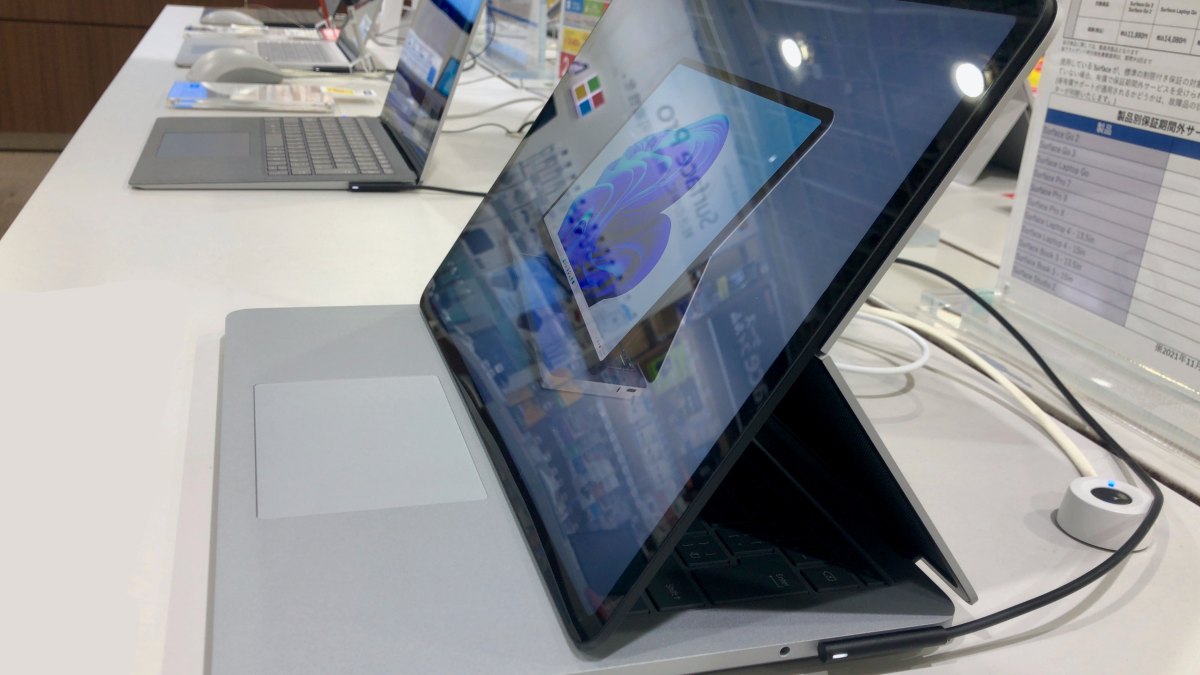
Microsoft held its first live launch event in two years in San Francisco on Tuesday, and it put the two people it needed on stage: CEO Satya Nadella and Nvidia CEO Jensen Huang. The product between them was the Surface Laptop Ultra, the first laptop built on the Nvidia RTX Spark system-on-chip - and, at a starting price of $2,599 with shipments beginning October 16, the most aggressive attempt yet to move frontier-scale AI work off the cloud and onto a consumer machine. "We have reinvented the computer as we know it," Huang said on stage. In China, the laptop starts at 21,988 yuan.
The specification that matters most is memory. The Ultra ships in two RTX Spark configurations - an 18-core CPU paired with a 5,120-core Blackwell GPU, and a 20-core CPU with 6,144 GPU cores - with up to 128GB of LPDDR5x unified memory and roughly one petaflop of FP4 AI performance. Because the memory pool is unified rather than bound to physical VRAM limits, allocations can be reassigned per application; Microsoft demonstrated AAA gaming (Gears of War: E-Day) and local model serving on the same machine. The company says the top configuration can run models with more than 120 billion parameters entirely on device - the class of model businesses currently rent data-center GPU time to serve. The RTX Spark itself, prototyped at Computex on May 31, pairs a Grace-derived CPU co-designed with MediaTek on a TSMC 3-nanometer process with a Blackwell GPU, and is compatible with the full CUDA stack plus Microsoft and Adobe ecosystems.
Against Apple, the numbers are Microsoft's own and have not been independently verified: the company claims up to 4.3x faster image generation and 6.2x faster video generation than the MacBook Pro M5 Pro. The hardware itself is aimed squarely at the developer-and-creator crowd: under 18 millimeters thick, about 2.0 kilograms, with a redesigned thermal system the company puts at 2.5 times the cooling capacity of existing Surface laptops. Native local-model support covers llama.cpp plus DeepSeek and Nvidia Nemotron builds, and the device runs MAI Code 1.1 Flash - the 130-billion-parameter coding model Microsoft announced for Windows 11 on Tuesday - directly on the hardware.
The laptop is the flagship of a wider bet. Copilot is being reorganized into Home, Code and Autopilot tabs; Microsoft Execution Containers for sandboxing autonomous agents are now generally available; and a "hybrid intelligence" layer routes each task between local and cloud models based on sensitivity, latency and capability. Meta's Muse agent is coming to Windows as a native app. For developers who need more than a laptop chassis allows, the $5,999 Surface RTX Spark Dev Box opened preorders alongside - a desktop unit with the same 128GB unified memory and one petaflop of rated compute, its chassis pierced by exactly 1,000 vents in a nod to the spec.
Two economic arguments hang on the launch. The first is the one cloud-inference startups will feel: a machine that runs a 120-billion-parameter model locally, after a one-time hardware payment and with no per-token bill, thins the margin of products built as wrappers around rented GPU time. Nvidia is not targeting that business deliberately - extending the CUDA moat down to the desk does it as a side effect. The second is the OEM wave: Asus, Dell, HP, Lenovo and MSI all announced RTX Spark systems in the same week, from the ProArt P16 to the XPS 16 Creator Edition, making this the first time six vendors have bet one chip platform in a single season. It is also a notable quantity of memory to commit at scale: Nvidia cut the DGX Spark's memory by half just last week to hold a price target, as DRAM contract prices climb toward double-digit quarterly gains. Whether a 128GB unified-memory laptop at $2,599 survives that cost curve - and whether local inference really displaces the cloud at scale - is the question the next quarter answers.
Preorders are open now; the Surface Laptop Ultra ships October 16.
Comments (0)
Log in to join the discussion
Log InNo comments yet