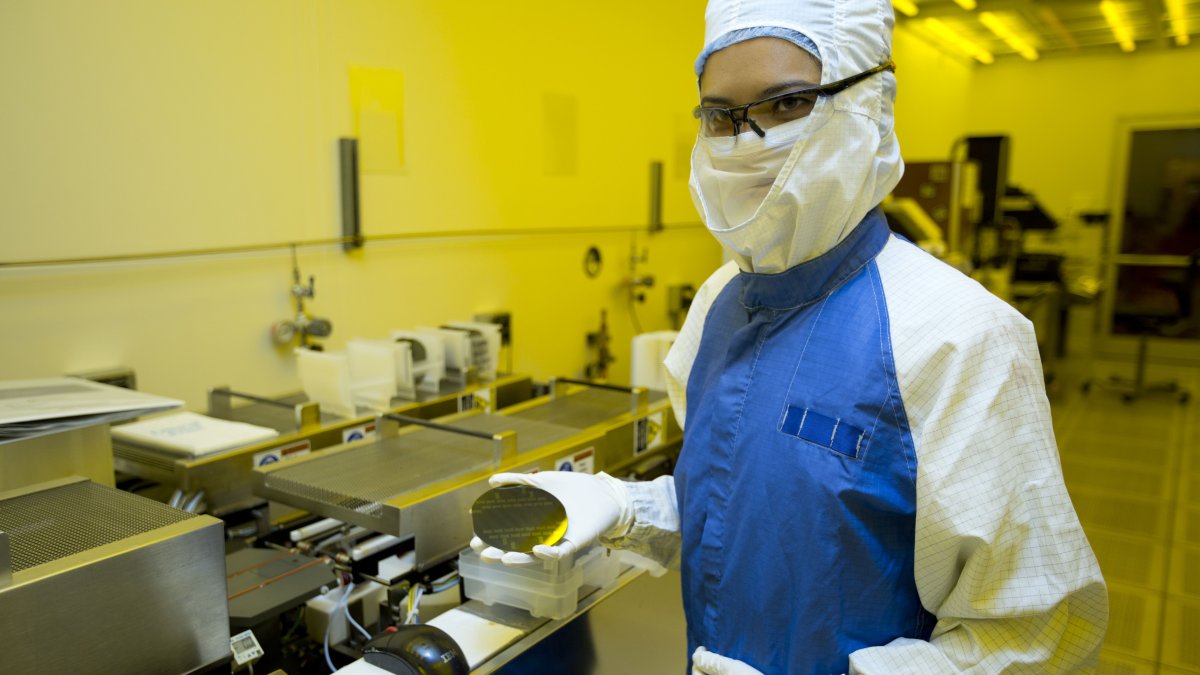
Rapidus, the Japanese government-backed foundry betting it can leap straight to the 2nm frontier, has missed a milestone it publicly committed to: producing working SRAM cells. Bloomberg reported November 10, citing people familiar with the matter, that the company has yet to manufacture functional static random-access memory - a validation step its roadmap had slated for completion before summer 2026, as a precondition for mass production by March 2028.
Why SRAM matters: it is the industry's standard proof that a process node has moved from "can make a transistor" to "can make a chip." A modern processor integrates hundreds of millions of SRAM cells used for on-die cache, and each one must hold precise electrical characteristics at microscopic scale with stable read-write behavior. Single-transistor demos flatter a process; dense SRAM arrays expose every weakness in device matching and yield. For 2nm-class gate-all-around processes, the SRAM cell is the most closely watched gate of all.
The arc so far tracks the slippage. Rapidus announced a working 2nm GAA transistor prototype in July 2025, which was received as real progress. Since then, public technical milestones have been limited largely to process design kit releases rather than functional circuits. The company's IIM-1 plant in Chitose, Hokkaido, started its trial line in April 2025, developed jointly with IBM and Belgian research center imec. Bloomberg adds that engineers are also wrestling with cleanroom dust and particle control - a persistent challenge for advanced-node yield - and that the team is under heavy pressure to catch up.
The company's public posture does not acknowledge the delay. Rapidus told Bloomberg it remains fully committed to starting mass production in the second half of fiscal 2027 - the October 2027 to March 2028 window - while declining to disclose technical progress as confidential. Chairman Tetsuro Higashi said as recently as last month that 2nm production was proceeding on schedule, a statement that now sits uneasily beside the reporting.
What is at stake goes beyond one company. Japan has poured more than 2 trillion yen in public money into Rapidus through NEDO and other channels - roughly 13 billion dollars - with economy minister Ryosei Akazawa saying the government is prepared to keep supporting the company until it can stand on its own financially. Rapidus was founded in 2022 by Toyota, Sony, NTT, SoftBank and four other Japanese companies, and has deliberately skipped mature nodes to aim directly at the leading edge, where AI demand has created scarcity but where TSMC and Samsung hold years of accumulated production experience.
On the demand side, Rapidus has signed cooperation agreements with 17 chip design-related companies including Synopsys and Infosys, hoping to help customers design chips for its process. But prospective customers remain cautious about moving leading-edge capacity away from foundries with proven ramp records - and each slipped internal milestone makes that calculus harder. For an AI industry betting on a wave of new 2nm capacity in 2027 and 2028, Rapidus's SRAM cells are among the most consequential things not yet built.
Comments (0)
Log in to join the discussion
Log InNo comments yet