Path Robotics, an Ohio startup building what it calls physical AI for manufacturing, announced on Monday a $300 million Series E financing at a post-money valuation of $2.45 billion, nearly quadrupling its previous valuation. The round was led by Georgian, an AI-focused growth equity firm, whose partner Emily Walsh joins the board. Existing investors Addition, Drive Capital, IronArc Ventures, Tiger Global and Yamaha Motor Ventures returned, joined by new backers D. E. Shaw Ventures and NAVER Ventures, bringing total funding to roughly $610 million since the company's 2018 founding.
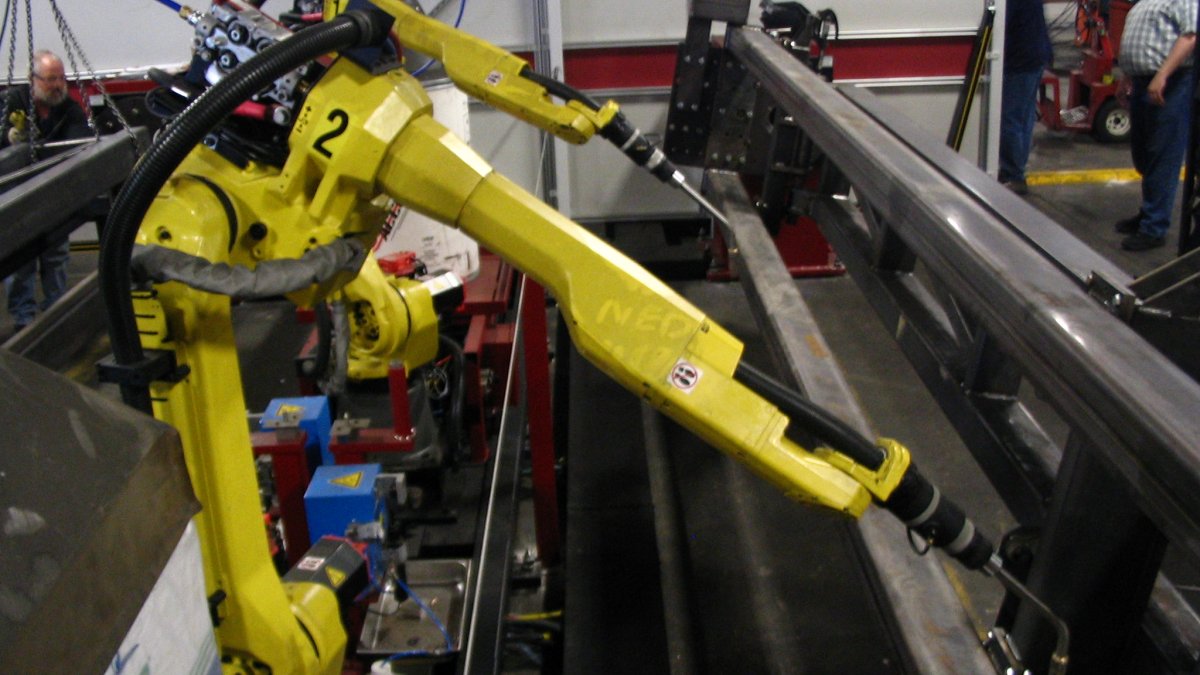
The commercial pitch behind the round is welding, one of the hardest factory jobs to automate because no two joints are quite alike. Path's Obsidian model lets robots perceive their environment, identify weld joints and adapt in real time instead of following rigid preprogrammed paths. The company says annual recurring revenue grew 17-fold over the past 18 months as deployments spread across major industrial customers, and that headcount is up 97 percent year over year, targeting 400 employees by year-end. Both are company-reported figures, not independently audited.
The customer list explains the valuation. Path counts Huntington Ingalls Industries, the largest US military shipbuilder, and Saronic, which builds autonomous maritime vessels, among its customers, alongside mid-sized US manufacturers. Earlier this year the company announced a $600 million performance-based production agreement with HII to push physical AI across US Navy shipbuilding programs, and Lockheed Martin Ventures, an investor, publicly endorsed the round as a way to expand capacity for defense production.
The new capital funds a broadening of the platform beyond welding. Path recently introduced Rove, a quadruped robotic welding system built on a modified Boston Dynamics platform that carries Obsidian's capabilities to shipyards, construction sites and heavy industrial campuses where fixed arms cannot reach; the company says it is working through roughly 50 preorders with deployments beginning next year. Management's stated goal is to automate not one step but the entire factory, expanding into the tasks before and after welding and into new robotic form factors.
The round fits a broader pattern: as reshoring and skilled-labor shortages squeeze US industrial capacity, investors are pouring growth-stage money into robots that learn rather than get programmed. It also marks a rare growth bet on hardware-adjacent AI at a time when most large rounds still flow to foundation models. Georgian's Walsh argued Path's growing base of real-world production data creates a compounding advantage with every deployment.
The open question is how quickly Path can prove its models generalize beyond the welding seam, where they were built, into adjacent tasks like inspection, fitting and material handling, where rivals with general-purpose robot foundations are also heading. The valuation now assumes the answer is yes.
Comments (0)
Log in to join the discussion
Log InNo comments yet