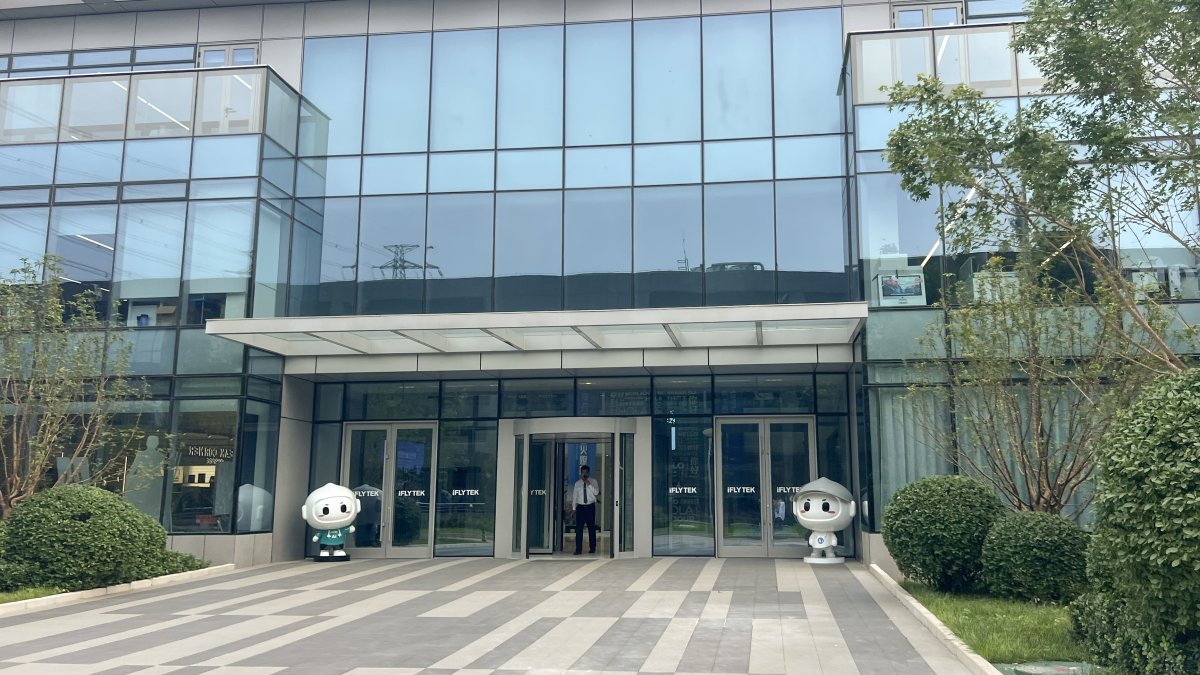
While most of the world's frontier models still run on NVIDIA silicon, iFlytek used its annual 1024 Developer Festival in Beijing on October 22 to stake out the opposite position. The company launched Spark X2.6, an upgrade of its flagship foundation model that it says was trained entirely on domestic Chinese compute, and put aggressive pricing behind the claim: 0.9 yuan per million input tokens, 0.08 yuan for cache-hit input and 3.6 yuan per million output tokens on a limited-time basis.
The spec sheet puts X2.6 in familiar company: a 293B-parameter mixture-of-experts architecture with 30 billion active parameters and a context window stretched to 1 million tokens. According to iFlytek's own comparison, the cache-miss input price and output price both come in below DeepSeek-V4.1-Flash-1017, the current Chinese price benchmark. The company says the model first breaks through on code and agentic capability using purely domestic compute, ranking first on the SWE Pro and SWE Multilingual coding suites and second only to DeepSeek-V4.1-Flash-1017 on SWE Verified - all company-reported results.
Getting there required engineering around the known weaknesses of domestic accelerators, which iFlytek chairman Liu Qingfeng candidly placed about two generations behind global hardware. On a 10,000-card "Feixing-2" cluster, the company says its dynamic parallel training technique for long-horizon tasks cut a 2000B-scale, 256K-length training run from 4.5 months to 1.2 months, roughly a 4x efficiency gain. On the inference side it claims 4.5x improvement and a KVCache hit rate lifted from 63 percent to 95.7 percent via what it describes as the industry's first four-layer KVCache architecture adapted to domestic hardware. None of these figures has been independently verified.
The more distinctive pitch is the edge-cloud architecture. iFlytek open-sourced Spark X2.6-4B, an on-device model with three inference modes that it says beats its own X2.5-4B as well as Qwen3.5-4B, Gemma4-E4B and Qwen3.5-9B on information search, document processing, scheduling, local spreadsheet operations and multi-turn tool calling - again, by its own tests. A routing mechanism decides per task whether it runs on-device, in the cloud or across both, with routing accuracy reported at 96.1 percent. Liu predicted roughly 60 percent of future tasks will run locally, 30 percent in edge-cloud cooperation and 10 percent purely in the cloud. The predecessor X2.5-4B, open-sourced in September, has accumulated 2.56 million downloads and ranks among the top four on-device models globally by that measure.
The launch was a full-stack event rather than a model drop. iFlytek also introduced SparkAudio 1.0, a speech foundation model; embodied multimodal interaction technology for robots; WinWork, a digital-employee platform for enterprises; and an education-focused agent workspace. On hardware it showed the Lingji N9000 AI PC with up to 160 TOPS of local compute, an office all-in-one with 2,240 TOPS for private model deployment, AI glasses and an AI recording ring.
The commercial backdrop explains the urgency. iFlytek's third-quarter revenue rose 7.99 percent to about 6.56 billion yuan with net profit up 31.05 percent to 226 million yuan, while R&D spending grew 20.78 percent to more than 3.8 billion yuan, according to company filings reported by Chinese media. The company sells into education, healthcare, legal, automotive and government sectors where data boundaries and compliance favor domestic full-stack solutions - Liu argued that a fully self-controllable model stack is "the inevitable choice" for AI security and extreme cost efficiency.
The strategic question is whether "trained on domestic chips" becomes a durable moat or a constraint. X2.6's pricing shows Chinese labs are still locked in a race to the bottom on cost, and iFlytek is betting that sovereign compute plus edge-cloud economics wins enterprise deployments even if raw capability trails NVIDIA-trained rivals. With DeepSeek, Alibaba and Moonshot all shipping on shorter cycles, iFlytek is choosing a different axis of competition - and its 1024 festival exists precisely to sell that story to developers and government buyers.
Comments (0)
Log in to join the discussion
Log InNo comments yet