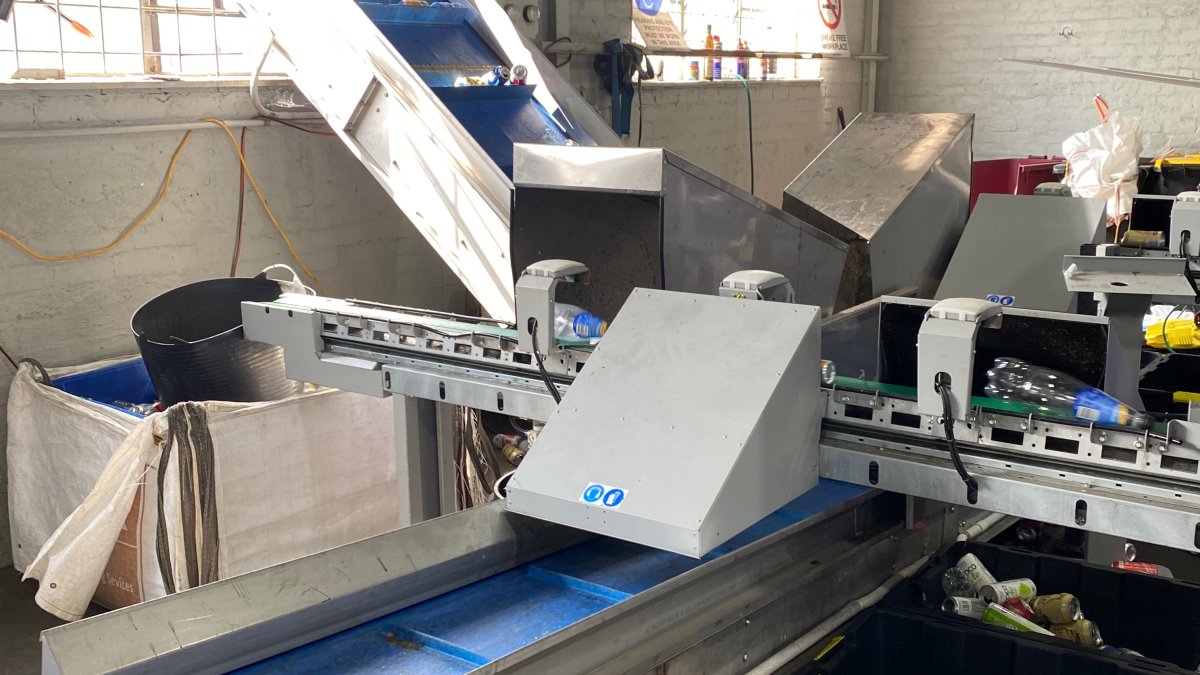
Danu Robotics, a six-year-old startup based in Edinburgh, has raised $5 million in a late-seed round to commercialize H.E.R.O., an AI-powered robot that picks recyclable material off conveyor belts, the company told TechCrunch. The funding arrives as the company moves from prototype to paid deployments in an industry that still sorts most of its recycling by hand.
Founder Amy Ma, who worked as a software developer at a London bank before starting the company, traces the idea to an office detail: her employer carefully separated its recycling, and the bins were emptied into the trash anyway. Digging into the industry, she found that a large share of sorting is still done by human pickers standing along a moving line, pulling cardboard and plastic bottles off the belt for hours at a time.
H.E.R.O. takes a different mechanical approach from most of its competitors. Rivals such as Glacier and RecycleEye rely on suction arms, which struggle with crushed cans, soaked cardboard and plastic film. Danu's machine uses a pincer claw, which the company says handles a wider range of shapes without dropping picks. The unit is designed to retrofit into existing manual facilities, occupies less than a meter of conveyor and can be installed in under a day, and it is deployed in a two-robot, multi-arm team format that Ma compares to a group of human pickers. The vision system keeps training on new waste streams after installation, so accuracy is meant to compound over time.
The commercial proof is early but concrete. Danu holds about $500,000 in signed contracts, has letters of interest from two large customers, and lists a sales pipeline of more than 200 facilities across a sorting market that TechCrunch sizes at roughly $20 billion across Europe and North America.
The economics are the pitch, with an important caveat. Ma estimates that a working site earns about $485,000 in additional annual revenue from the robot's sorted output, against a unit cost of $160,000 and roughly $24,000 a year in maintenance, which works out to a payback period of about four months. Those figures are company estimates and have not been independently verified, and the pick accuracy Danu cites counts a pick only when the object actually lands in the bin.
The next step is to make the robot sturdier, smaller and more versatile so it can operate outside dedicated facilities. Ma has suggested standalone versions for events, shopping centers, hospitals and airports, where waste would be sorted at the source rather than at a materials recovery plant. If the economics hold outside the demo environment, the target is one of the last major industries where meaningful production work is still done by hand.
Comments (0)
Log in to join the discussion
Log InNo comments yet