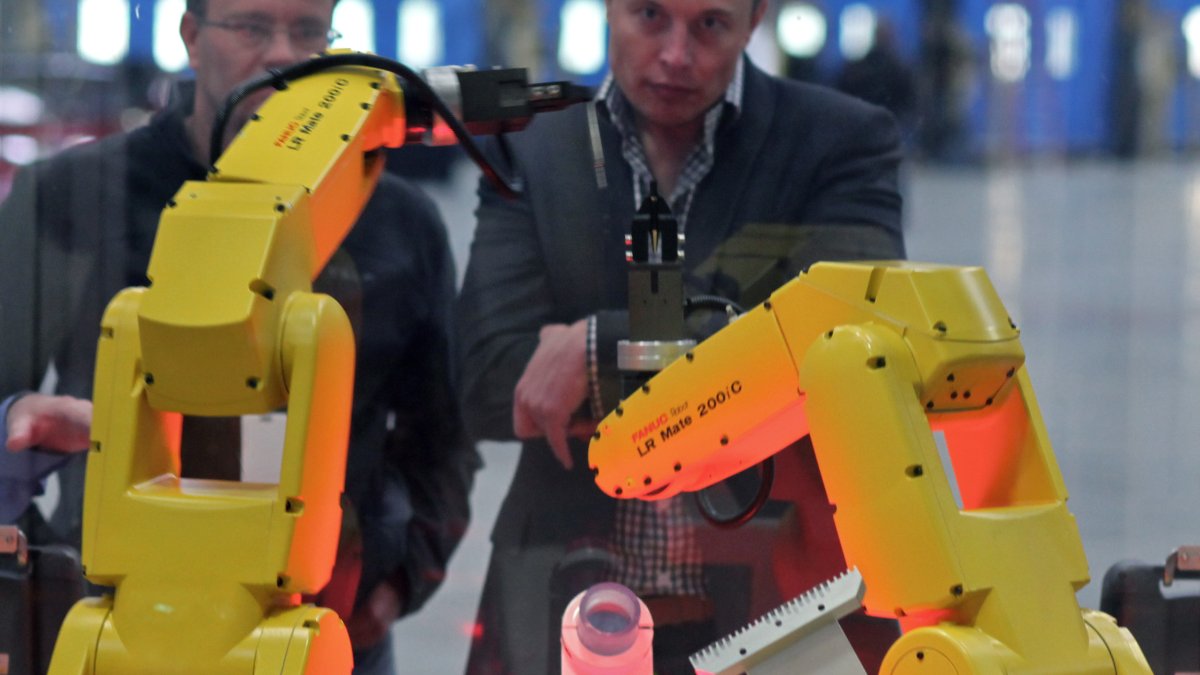
ROKAE Robotics, a Chinese industrial robot maker listed on the Hong Kong Stock Exchange under ticker 3752, said it has delivered its 10,000th humanoid force-controlled arm. The milestone unit rolled off the company's production line in Shandong Province in September, and the company publicized the figure on Monday through a PR Newswire release.
The arms are compact but densely engineered. Every joint in the AR Series provides force control, allowing the arm to sense and respond to contact with objects rather than just execute pre-set paths. A palm-sized MAC controller measuring 213 by 145.5 by 45 millimeters can drive all seven joints of a single arm, all 14 joints of a paired-arm setup, or more than 20 joints across a full humanoid robot, depending on configuration.
The flagship deployment is at Schaeffler's lighthouse factory in Taicang, China, where five ROKAE Helios wheeled humanoid robots equipped with the AR Series arms work on an assembly line that produces components for humanoid robots. The robots handle parts, assembly and inspection tasks on the line, which ROKAE presents as evidence that force-controlled robotic systems can hold up in continuous production environments rather than trade show demos.
By the company's own count, more than 80 industrial partners have integrated its humanoid force-controlled arms into production applications. That figure sits alongside its broader business: ROKAE, founded in 2014, serves more than 1,000 enterprise customers across more than 40 countries with industrial robots, cobots and embodied intelligent robots. The 10,000-unit milestone covers the humanoid arm product line only, separate from its installed base of industrial and collaborative robots.
Founder and CEO Tuo Hua put the milestone in characteristically restrained terms. The number itself matters less than the trust behind it, he said in the release, adding that there are no shortcuts in force control and that reaching 10,000 units means delivering consistent performance across hardware, control algorithms and manufacturing processes at scale.
Force control has quietly become one of the defining bottlenecks of the embodied AI race. Position-controlled arms can repeat choreographed motions, but contact-rich work like assembly requires robots that can feel torque and compliance joint by joint, which is exactly the capability both humanoid startups and automotive suppliers are racing to industrialize.
A company producing its own robot components with robots is also a snapshot of where the Chinese robotics supply chain now sits: deep enough at the component level that a single supplier can count five humanoids working a production line as routine reference customers. As always with vendor-reported milestones, independent verification is thin, but the deployment at a Schaeffler plant is the kind of claim a customer would have to co-sign.
Comments (0)
Log in to join the discussion
Log InNo comments yet