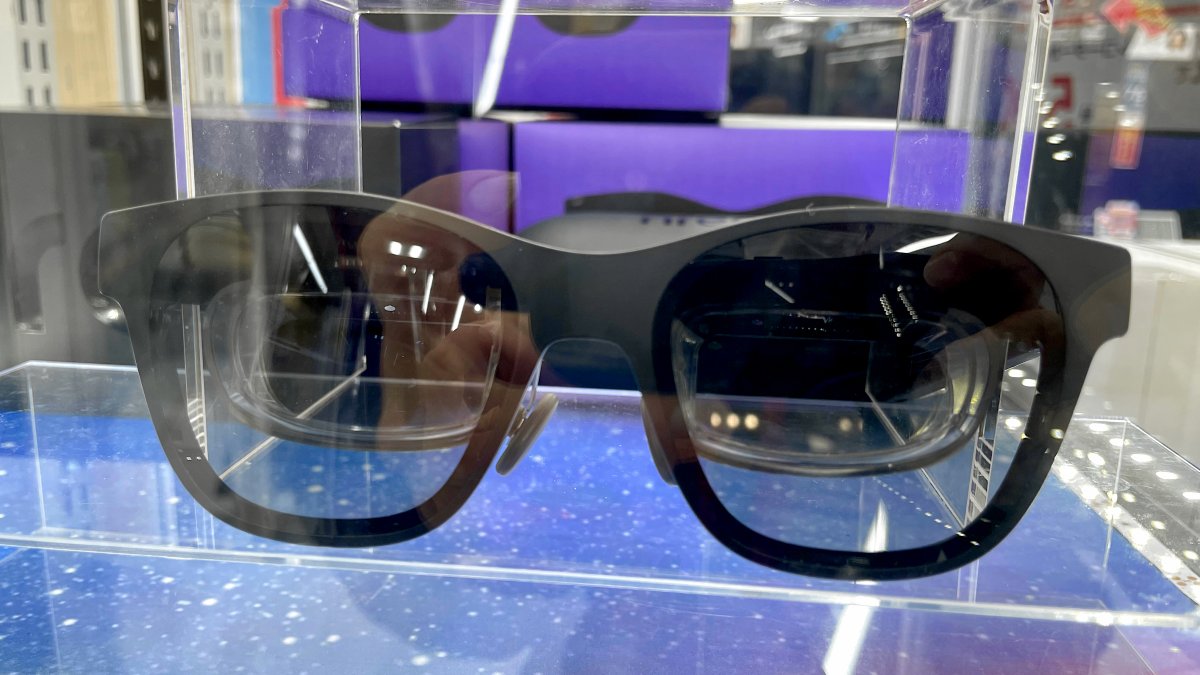
XREAL launched Aura on October 28, announcing it on stage at Google's Android Developer Summit and opening orders the same day in the United States, Canada, Japan and South Korea. It is the first wired pair of XR glasses running Android XR, and the first to ship on Qualcomm's Snapdragon Reality Elite platform. Devices are expected to start reaching buyers in mid-November.
The launch pricing is the part retailers will lead with. The 12GB RAM and 256GB storage model is $1,099 through December against a list price of $1,279, and the 16GB and 512GB model is $1,299 against $1,499. That is $180 and $200 below the prices XREAL floated earlier this month. XREAL general manager Ralph Jodice told The Verge that customers who pre-ordered at the higher figure will have the difference refunded automatically.
The hardware is a deliberate compromise. Aura uses transparent optical see-through lenses rather than an enclosed headset, weighs under 95 grams, and pushes the battery and the main compute into a wired puck that doubles as a trackpad. The displays are Sony micro-OLED at 1200p and 120Hz, the field of view is 70 degrees, and audio comes from Bose-tuned speakers with electrochromic dimming to darken the lenses. XREAL's own chip, the X1S, sits in the glasses. The 70-degree figure is XREAL's number, not an independent measurement, and the cable between glasses and puck is the trade-off that keeps the weight down.
On the software side Aura runs Android XR with access to Google Play, so the pitch is millions of existing apps in a spatial window rather than a new app economy. Gemini is the differentiator XREAL and Google are selling: it can see what is in front of the wearer, including a mirrored laptop window, and now highlight what the user should focus on. Wired mirroring over USB-C turns a laptop or a handheld console into a large private display, which is the use case most likely to justify the puck on a plane or in a hotel room.
XREAL says more than 150 made-for-XR experiences are available at launch, including an NBA app that can show three games at once with a League Pass subscription, Nevatars from Andy Serkis, and Fallout: Factions. Two accessories were announced without prices or dates: a GameSir-built controller with a dedicated Gemini key, and a wireless portable keyboard.
The strategic question for Google is whether opening Android XR to a hardware partner with XREAL's optical engineering gets it into the glasses market faster than building its own device. For XREAL, which spent years selling phone-tethered display glasses as accessories, Aura is an attempt to become a standalone computer that happens to be worn. The $1,099 launch price puts it in laptop territory, and the company is clearly counting on the December deadline to pull early buyers off the fence.
What it means is that the AI assistant, not the virtual screen, is now the reason to wear a computer. A display in glasses has been sellable for a decade as a niche; an assistant that can see your room, read your screen and answer in context is a different argument, and it is the one Google and XREAL are making. Whether buyers accept a tethered puck and a 70-degree window to get it will be settled in the first quarter of sales, not in the keynote.
Comments (0)
Log in to join the discussion
Log InNo comments yet