Autonomous laboratories have mostly been "add-on" systems: experts configure the instruments and fix the workflow, then AI handles one slice of the pipeline such as literature search or data analysis. A team at Shanghai Jiao Tong University has flipped that architecture, and Nature published the result on November 4 with homepage headline treatment — an AI-native molecular biology laboratory called AutoDNA that organizes experiments end to end, from natural-language request to physical instrument operations.
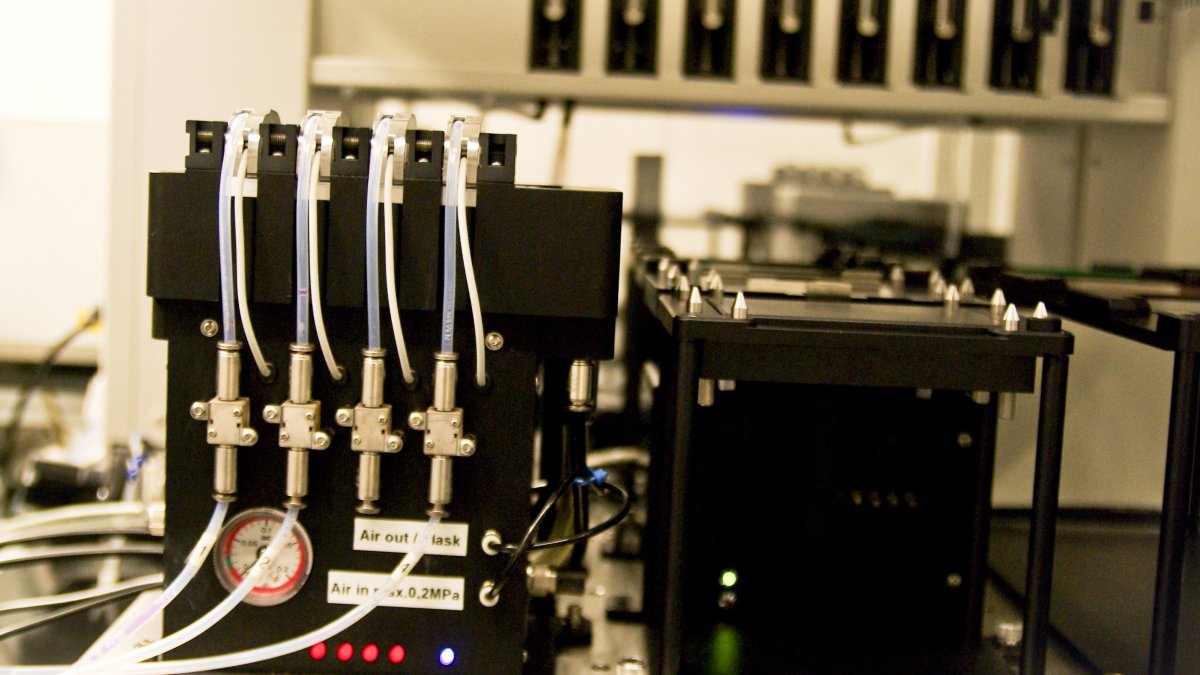
The system, designated Siyuan-1, is built around a multi-agent architecture. A central planning agent coordinates six specialist agents — covering literature, reagents, protocol design, code generation, hardware execution and hypothesis iteration — so the platform can move through a design-experiment-optimize loop and adjust plans based on results. The hardware abstraction layer is the genuinely novel piece: the team distilled the capabilities of more than 20 instrument classes into "atomic services" that models can call like APIs, described in natural language with unified code interfaces, letting a model compose cross-device control code without knowing each machine's quirks. Precision hardware provides microliter liquid handling and micron-level positioning, with an integration of the OpenHarmony operating system as the control terminal.
The validation results carry the numbers. In a full end-to-end DNA data storage run, AutoDNA orchestrated 11,382 automated hardware operations over 203.5 hours across encoding, synthesis, storage, nanopore sequencing and decoding, recovering 78 data-bearing DNA strands with content identical to what was written — zero errors across a multi-day, multi-instrument workflow. In protocol optimization, the system's eighth iteration of enzymatic DNA synthesis reached a 97.8 percent single-step yield, comparable to expert manual optimization. Running experiments in parallel cut average total time from 1,433.7 minutes to 454.0 minutes, a 3.2-times speedup. And in a clinical-style test on a colorectal cancer sample of previously unknown sequence, the platform autonomously sequenced the sample, identified the KRAS G13D mutation, designed verification primers and passed validation on the first synthesis attempt.
The work comes from a collaboration between the university's IPADS systems group (Chen Haibo and Wang Zhaoguo) and the chemistry and molecular science teams of Fan Chunhai and Wang Fei, based at the Zhangjiang DNA storage research center. The authors position the result as "science as a service" — AI moving from assisting individual experiments to operating the laboratory itself.
The caveats are the usual ones for autonomous-science demos: the platform needs humans for physical logistics — reagent refills, consumables, equipment maintenance — and the showcased applications are those the team chose. But the pattern is hard to miss: this is the second autonomous-lab milestone in weeks where multi-agent orchestration, not a better model, was the differentiator. For wet-lab-intensive industries, the bottleneck is shifting from what models know to what instruments they can actually drive.
Comments (0)
Log in to join the discussion
Log InNo comments yet