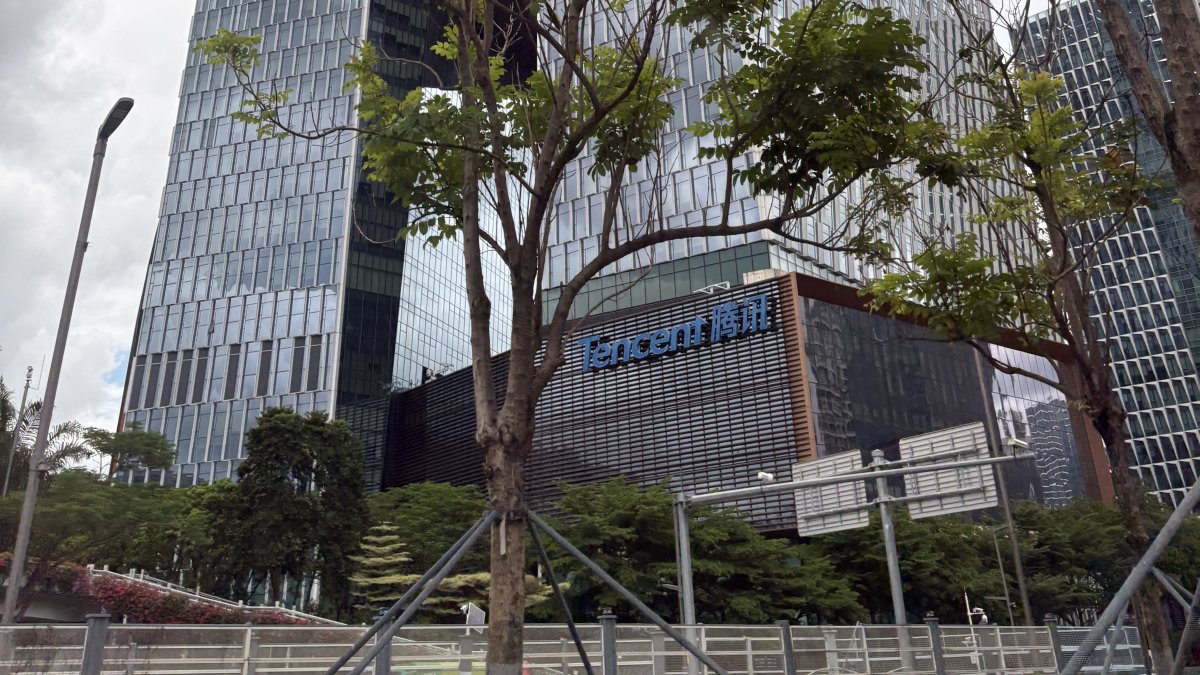
A typical production vision pipeline chains together four or five specialist models: an open-vocabulary detector, a counting head, an OCR engine, a segmenter, and a background-removal service. Tencent's WeChat Vision team has published an open-weight alternative that collapses the chain into one system. WeVisOne-VL, released in 2B and 4B variants under the Apache 2.0 license, performs open-vocabulary detection, referring localization, counting, pointing, OCR, segmentation and alpha matting from a single vision-language model.
The architecture leans on structured coordinate tokens: boxes, points, masks and OCR groundings are all emitted as tokens in one output format, so a natural-language instruction like "find the blue suitcase and cut it out" returns a usable mask instead of a polygon estimate from a separate tool. A lightweight 9.6-million-parameter pixel decoder produces the masks and alpha mattes, which means the model does not need SAM or any external segmentation backbone bolted on.
One design choice stands out for real-world deployments: the model can say nothing is there. Instead of always returning a location, WeVisOne-VL supports an explicit absent-object response, so a query for an item that is not in the frame comes back as a rejection rather than a hallucinated bounding box. Tencent reports 96.4 percent rejection accuracy on its WeRef-Bench for the 4B model, alongside 55.3 LVIS F1 and 71.2 ReasonSeg gIoU — figures the company generated itself and have not been independently verified.
The 2B and 4B backbones are built on Qwen3-VL, and the release includes weights, evaluation code and support for local inference through either vanilla Transformers or vLLM, which matters for teams with data-residency constraints. The accompanying paper was submitted on October 22, and the project page with demos lives under Tencent's GitHub organization.
The caveats are cost and scope. Even at 2B and 4B, high-resolution pixel tasks such as full-image matting still demand serious GPU resources, and for narrow single-task workloads a small specialist model can remain cheaper to run. Unified perception also concentrates risk: a model that does everything can be wrong at everything at once, so teams still need confidence thresholds and human review for anything consequential.
The strategic reading is broader than one model. Chinese labs have spent the month shipping open-weight perception and speech systems — Moonshot's Kimi K3.1 Pro, Ant Group's Ming-3.0 TTS, Hi3D for 3D assets — and WeVisOne-VL extends that pattern into industrial computer vision, an area where Western labs have mostly stayed closed. For e-commerce, document processing and image-editing pipelines, an Apache 2.0 model that removes three vendor dependencies is a practical choice, not just a research one.
Comments (0)
Log in to join the discussion
Log InNo comments yet