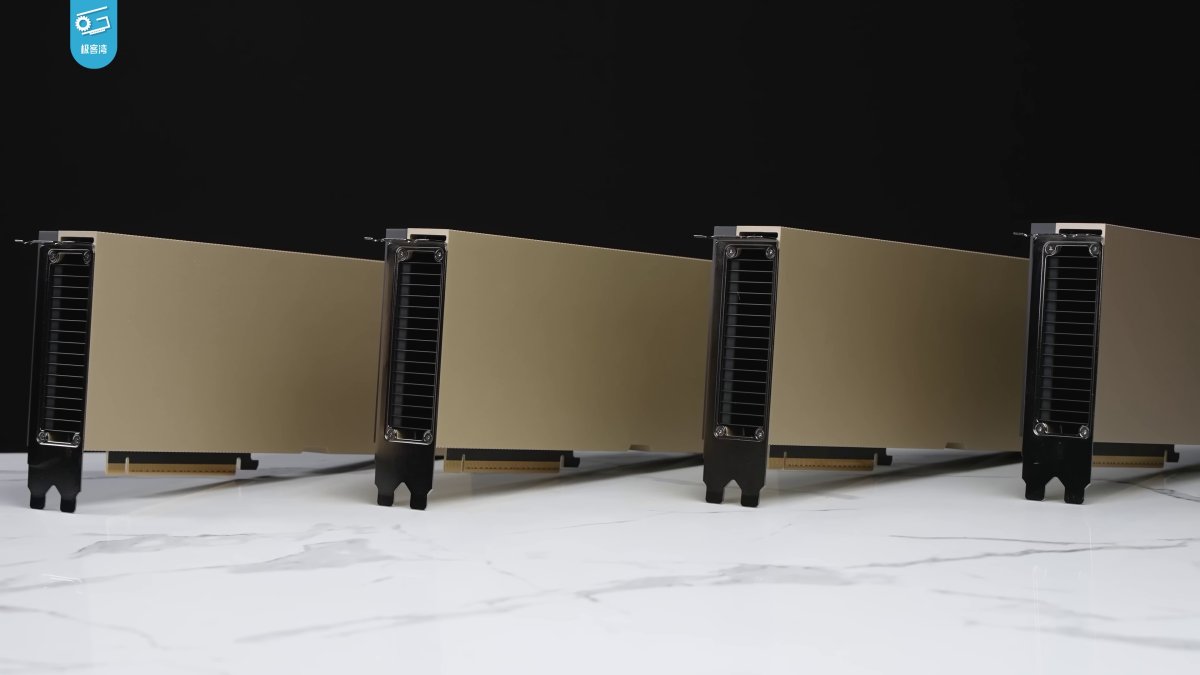
The Justice Department on Thursday announced the arrest of Greg Lui, the 38-year-old owner of California-based server provider Earthmade Computer, in one of the largest export-control cases of the year: a scheme prosecutors say moved more than $300 million worth of high-end computer servers — packed with Nvidia A100 and H100 AI chips as well as GeForce RTX 4090 and 5090 gaming GPUs — from US manufacturers to Chinese buyers through fake paperwork and third-country transshipment.
Lui, who also goes by Yiu Kong Lui and lists himself as CEO of Earthmade on LinkedIn, was reportedly arrested outside the company's offices in the City of Industry, California. A federal grand jury secretly returned a 22-page indictment on September 29; it was unsealed after his arrest. He is charged with conspiring to violate the Export Control Reform Act and Export Administration Regulations, outbound smuggling, and money laundering conspiracy — counts that carry a combined maximum of 50 years in prison. Prosecutors are also seeking forfeiture of all proceeds.
The alleged playbook was straightforward. Earthmade, a server hardware vendor with ties to Nvidia partner Supermicro, placed orders with US manufacturers for export-controlled servers, then shipped them to Malaysia and Singapore — countries that require no US export license — where co-conspirators forwarded them to China. The indictment alleges Lui worked with five unnamed co-conspirators from October 2023 through at least August 2026, though most of the documented purchases occurred in 2023 and 2024.
The court papers trace specific shipments in detail. In January 2024, Lui allegedly submitted a purchase order for 27 H100-equipped servers worth approximately $7.6 million; the machines flew from Los Angeles to Kuala Lumpur the next day, and a co-conspirator later told a Malaysian government official that all 27 had been shipped to China. Another batch of 92 servers flew from San Francisco to Kuala Lumpur via Singapore, with paperwork listing a Hong Kong consignee — the servers ended up with a company in Hangzhou, which US investigators note is one of China's AI hubs. In a third shipment of 100 H100 servers worth over $22 million, prosecutors say Lui submitted fraudulent documents from Topmost Corp, a California-registered front company, identifying a fictitious "Jackie Lui" as its CEO. The FBI also alleges Lui purchased someone else's identity documents in 2021 to conduct business for the scheme, and that payments flowed through his Bank of America and JPMorgan accounts — more than $176 million from two Malaysian transshipment firms in 2024 alone.
Officials framed the case in unusually pointed language — reflecting the Trump administration's rebranding of AI as "super intelligence," or SI. "Protecting America's national security means keeping our advanced super intelligence technology from being used to strengthen our adversaries' military capabilities," said US Attorney Bill Essayli. Justice Department national security chief John Eisenberg called SI "the defining technology of the era," and an FBI counterintelligence official said Lui sold the Chinese government "hundreds of millions of dollars" worth of American technology in violation of export laws.
Nvidia, which was not accused of wrongdoing, told PCMag that the case "shows yet again that smuggling is a losing proposition — legally, economically, and technically," adding that its work with law enforcement "has led to prosecutions, and we will continue to engage." The company has increasingly downplayed the scale of diversion: a spokesperson told Bloomberg this week that allegedly less than "one half of one percent" of Nvidia products have been diverted to China — "a drop in the bucket compared to the ocean of domestic compute China already has."
The arrest is nonetheless part of a widening pattern. In March, a co-founder of US server maker Supermicro was indicted in a $2.5 billion scheme to smuggle Nvidia GPUs to China; in August, Taiwanese authorities charged nine people — including employees of Nvidia and Supermicro — over illegal exports of high-end AI servers. Industry estimates of the true scale of the shadow trade run far higher than arrest records suggest: a 2025 Financial Times report estimated more than $1 billion in restricted chips reached China in just three months, and black-market GPUs sell at premiums of roughly 50% inside China. US officials are pushing Nvidia to flag more suspicious shipments voluntarily — because, as this case shows, the smugglers have moved on from tourists carrying single cards in luggage to entire server racks moving under commercial invoices.
Comments (0)
Log in to join the discussion
Log InNo comments yet