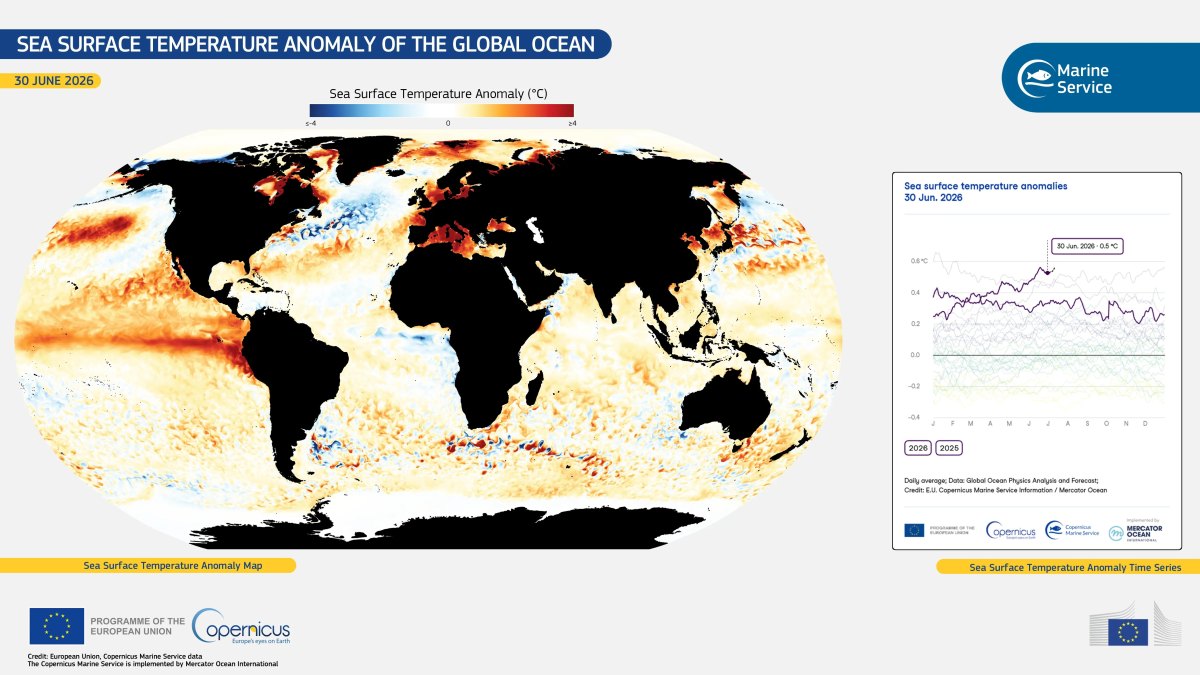
The tropical Pacific has entered territory no modern forecasting system has ever had to predict in real time. China's National Climate Center confirmed on October 9 that a super El Niño event formed in September, and expects the Niño 3.4 sea-surface index to peak at 3.2 to 3.5 degrees Celsius above normal around November — above any previous event on record. The World Meteorological Organization's latest seasonal update puts the October-to-December anomaly near 3.7 degrees, says there is a near 100 percent chance the event persists through February 2027, and warns it could rank as the strongest El Niño since records began in 1950, beyond the 1982-83, 1997-98 and 2015-16 super events.
That makes the next few months something more than a routine forecast season. The Financial Times reports that the historic El Niño amounts to a real-world stress test for AI weather forecasting, precisely as the technology moves from research curiosity to operational tool. Utilities, insurers, airlines and commodity traders already lean on AI-driven forecasts for pricing and planning decisions, which means an error now propagates into energy markets, crop insurance and logistics instead of staying on a meteorologist's chart.
The skeptics' concern is technical, not philosophical. AI weather models learn from decades of historical reanalysis data, and a super El Niño of this magnitude pushes the climate system into territory the models have never seen. Physics-based models also struggle with unprecedented states, but their equations are anchored to conservation laws rather than learned patterns — which is why some scientists question whether machine-learning systems can be trusted most when the stakes are highest.
The field is not starting from zero, though. Google DeepMind's GraphCast and its operational WeatherNext family, ECMWF's AIFS and Microsoft's Aurora have all posted medium-range results that match or beat leading physics models at a fraction of the compute cost, and forecast centers now run AI systems alongside conventional ensembles. Hybrid approaches are emerging as the practical answer: use AI for speed and ensemble breadth, physics for physical consistency, and ensemble spread to flag when a forecast is stepping into the unknown.
Meteorologists expect a nuanced verdict rather than a clean pass or fail. AI models will likely outperform in some regions and lag in others, and the most damaging scenario is not a quietly wrong map but a publicly visible miss — a major storm or wildfire where AI forecasts are compared line by line with traditional models and lose. In a domain where accuracy is measurable and the consequences are concrete, one high-profile failure could set adoption back years.
What to watch is concrete: the first major storm or flood of the El Niño season, where verification will be public; whether forecast misses begin feeding into food and energy prices; and whether insurers and grid operators adjust how much weight they give AI-driven guidance. With the super El Niño peaking around December, the verdict on machine-learning weather forecasting is only weeks away.
Comments (0)
Log in to join the discussion
Log InNo comments yet