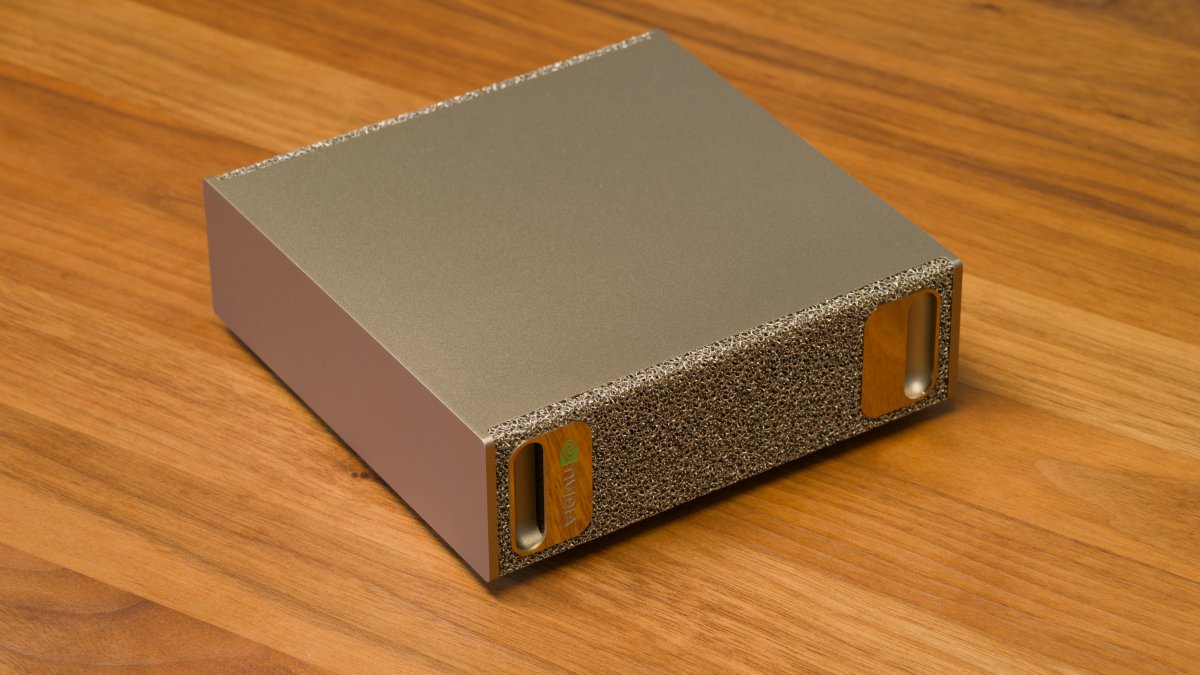
NVIDIA has announced a 64GB configuration of its DGX Spark desktop AI computer, going on sale Friday, October 23 at a starting price of $4,999 through manufacturer partners Acer, Asus, Dell, Gigabyte, HP and MSI. The new SKU keeps the same GB10 Grace Blackwell Superchip, DGX OS and full NVIDIA AI software stack as the existing 128GB model, and runs models of up to 100 billion parameters entirely on device. It is a separate product from RTX Spark, NVIDIA's consumer laptop platform confirmed earlier this week for an October 7 debut.
The memory cut is the story behind the story. DGX Spark launched at $3,999, then worked its way through price bumps as memory and component costs climbed - and the 128GB model has now moved past $6,000, with NVIDIA's FE version listed at $6,950 by IT Home's count. The 64GB configuration effectively takes over the $4,999 slot the 128GB model used to occupy, trading half the unified memory to keep the entry price intact while memory inflation reshapes the local AI hardware market.
The hardware itself is unchanged where it matters. Around 8GB of the 64GB is reserved for the system, leaving roughly 56GB for model weights and KV cache - enough, NVIDIA says, for models up to 100 billion parameters with quantization support including NVFP4. IT Home reports the box comfortably runs open models like Qwen3.8 27B, Gemma4 26B and Nemotron 3.5 Lightning. Every unit ships with a built-in ConnectX-7 NIC, and the software side is complete from day one: NVIDIA's Agent Toolkit, CUDA-X libraries, Nemotron open models, and runtimes including Ollama, vLLM and PyTorch with CUDA. Blender is among the first creator applications to add a prebuilt installer.
The scaling pitch is the new Sync Cluster Assistant. Two 64GB units connect directly with a QSFP cable, pooling memory to 128GB and expanding model support to up to 200 billion parameters, with twice the memory bandwidth and up to 1.7x the performance - measured by NVIDIA on its own Qwen 3.8 27B test, so treat the clustering gain as a company-reported figure. The assistant detects connected units, validates their configuration and sets up the ConnectX-7 network automatically, and a Sync Model Launcher due at the end of the month will download and launch models across a cluster, then wire up the OpenCode coding agent to use them. Developers can also reach the box remotely from an everyday PC through VS Code or Cursor.
The math deserves a skeptical read, and Tom's Hardware has done it. Two clustered 64GB units cost $9,998 - roughly $998 to $2,998 more than a single 128GB machine at current street prices of about $7,000 to $9,000. On NVIDIA's own 1.7x scaling result, each unit of throughput costs about 18% more in the pair. And the benchmark itself was run on a model that fits in 32GB with limited context, meaning the gain was measured on a workload that never needed the second box. NVIDIA also lists fine-tuning among the platform's uses; Tom's Hardware assigns that job to the 128GB model. The launch price may not hold either - the same report warns that shifting memory and storage prices mean the numbers "might not stay there for long."
There is competition pressure too. AMD's Ryzen AI Halo systems currently sell with 128GB of unified memory for around $4,699, and a 192GB configuration sits near $6,500 - more memory per dollar than either DGX Spark configuration right now. NVIDIA's counterweights are the CUDA software stack and the clustering path: no equivalent way to grow a small box into a bigger one by plugging in a cable.
NVIDIA's positioning for the 64GB unit is explicitly the agent workload: keep a coding or research agent running around the clock on device, privately, without a cloud dependency, and add a second unit only when the work outgrows the memory. Perplexity Computer is already available on DGX Spark for always-on agents. The honest summary is that $4,999 buys a genuine Grace Blackwell machine with a complete AI stack - and, in a market where memory prices keep climbing, a configuration that exists largely because the full-memory version stopped being affordable.
Comments (0)
Log in to join the discussion
Log InNo comments yet