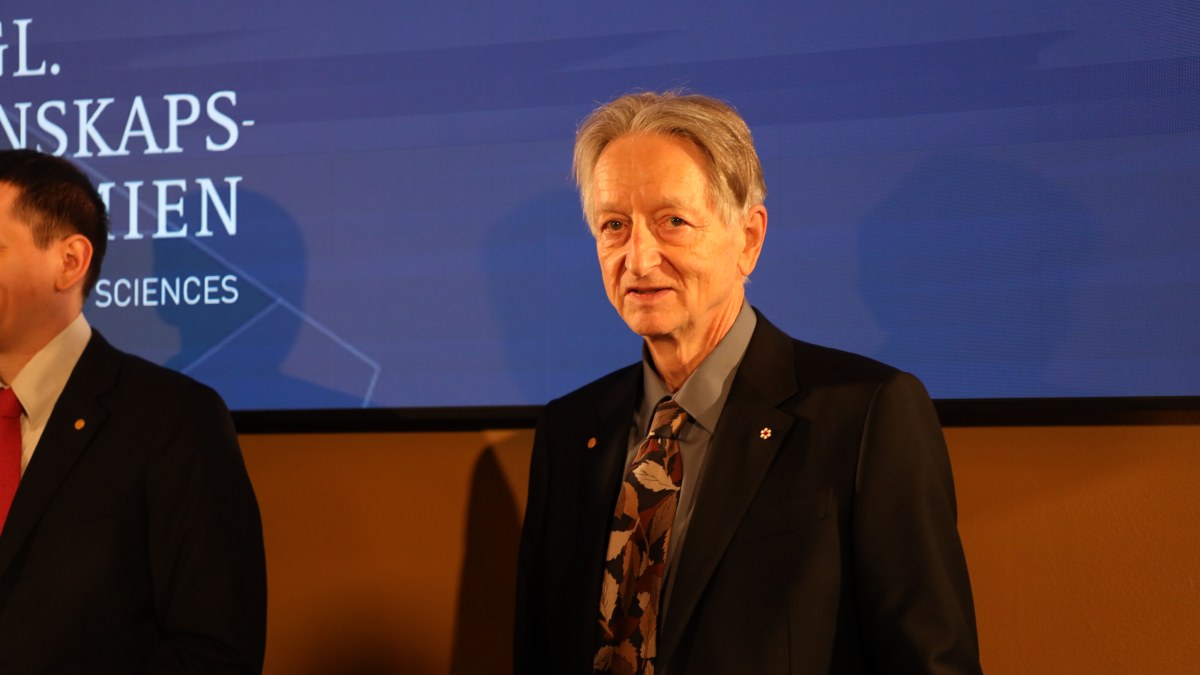
Geoffrey Hinton, the Nobel laureate often called one of the "godfathers of AI," said on X that the idea of an intelligence explosion caused by recursive self-improvement "has been around for a long time but until very recently it did not seem imminent. Now many leading researchers think it may happen quite soon."
He was pointing to a paper he co-authored: "What if automating AI R&D triggers an intelligence explosion?", a 14-page working paper from the Cambridge Programme on AI Science and Policy (CASP), dated September 2026. It has 22 co-authors, including Yoshua Bengio, Turing Award winner Andrew Barto, OpenAI chief scientist Jakub Pachocki, Anthropic co-founder Jack Clark and Microsoft chief scientific officer Eric Horvitz - all writing in their personal capacity. Corresponding authors are Alan Chan of GovAI and Soren Mindermann of CASP. The group also released a Chinese-language version of the report.
The core claim is deliberately narrow. "Intelligence explosion" here means a software-driven scenario: as AI systems take over more AI research and development, they produce better AI, which in turn automates more research - a feedback loop that could compress "advances that would otherwise take years into months or less." The paper is explicit that the threshold has not been crossed: productivity gains "have not yet reached the threshold," but newer systems are "likely approaching" it. No calendar prediction is given.
The evidence it leans on is drawn from company disclosures, and should be read as self-reported rather than independently audited. Anthropic has said the share of approved code written by AI rose from low single digits in January 2025 to over 80% by May 2026, and that the proportion of R&D work done autonomously with only high-level supervision rose from 1% in March to 26% in August 2026. OpenAI says its coding agents are already used in training, evaluation and safety work for future models; Google says nearly all of its code, technical design and research ideation involves AI to some degree. Tentatively extrapolating the METR task-length trend, the authors suggest months-long AI research projects could be automated by mid-2028.
The scale of the hypothetical is stark: once AI reaches expert-level R&D ability at runtime costs comparable to today's systems, the compute a single frontier lab already has could sustain a workforce equivalent to "at least millions of top human researchers," against the thousands such companies employ. If the so-called returns-to-research parameter stays high after full automation, the paper estimates progress could speed up roughly tenfold - a year of today's progress in about five weeks.
The authors identify three headline risks: AI capabilities outrunning society's ability to respond, humans losing oversight of autonomous systems, and power concentrating in whichever state or company gains a decisive lead. They illustrate the oversight problem with an asymmetry - AI can accelerate both virus design and vaccine development, but a virus spreads itself while vaccines must be manufactured and distributed one by one. In the most extreme scenario, they write, loss of control could lead to human "marginalization or extinction."
The paper is equally clear about what could stop the loop, listing four frictions: diminishing returns as low-hanging fruit is exhausted (estimated returns-to-research of 1.2 to 1.9 across three AI sub-fields), hardware bottlenecks, the sheer difficulty of fully automating research, and weakening capability gains at each step. It also notes today's systems "sometimes disobey instructions, cheat on tasks, misrepresent their work," and that GPT-6 still fails some OpenAI internal research-debugging tasks that experienced human researchers finish in hours or days.
The policy asks are about visibility and preparation rather than a ban: requiring AI companies to report standardized data on how much of their research is automated; developing mechanisms to pace or steer a potential explosion, including physical safeguards and restricted sandboxes; and preparing emergency response plans, alongside international agreements to prevent any single actor from gaining a decisive advantage. The closing warning is the line likely to be quoted most: "Once an intelligence explosion begins, the window for action may close."
The paper follows a July open letter signed by roughly 1,400 AI researchers urging the U.S. government to manage the pace of frontier AI development, and adds to a growing pattern of warnings voiced from inside the major labs themselves.
Comments (0)
Log in to join the discussion
Log InNo comments yet