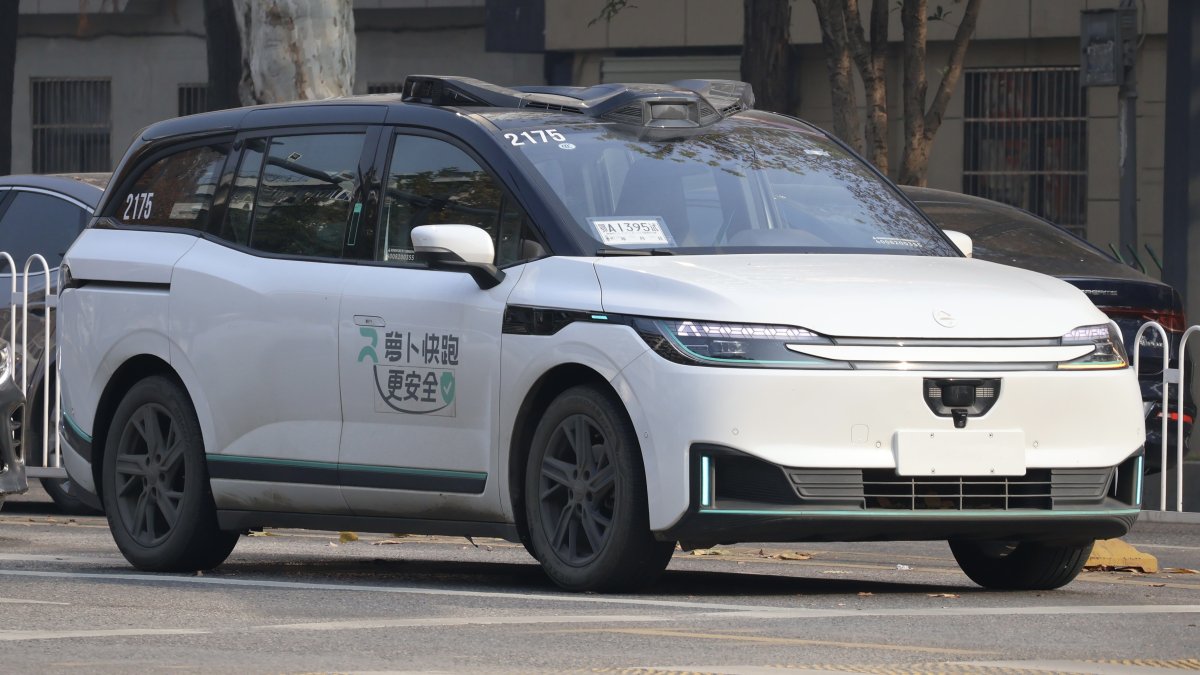
At its AI Day in Shenzhen on November 3, Baidu disclosed Apollo World, a full-modal world model for physical AI that treats every participant in a traffic scene as its own decision-making AI agent. The system is already being used to test and validate Apollo Go, Baidu's robotaxi service, before scenarios reach real roads.
In Apollo World's virtual cities, vehicles, pedestrians and other road users are modeled as agents with decision and interaction capabilities of their own. The model generates camera imagery and lidar point clouds in real time, so the driving stack perceives the virtual environment the way it would a real one. When the robotaxi brakes, changes lanes or yields, the simulated world responds — closing an end-to-end loop from perception to decision to feedback, including complete order-to-dropoff trips between arbitrary points in the virtual city.
The headline number is roughly 100,000 kilometers of virtual test driving per day, which Baidu says equals about three years of continuous real-road testing by one car with a safety driver. Wang Liang, chief architect of Baidu's Intelligent Driving Group, framed the philosophy bluntly: a world model should not be "a painter of cool videos" but an examiner that verifies safety. On open roads, he noted, the decision window is strictly bounded to one-thirtieth of a second — about 33 milliseconds.
Baidu also proposed a "2+3" evaluation standard for world models: causality and interactivity as the baseline threshold, then physical accuracy, persistence and real-time performance as the advanced bar. Yang Ze, who leads the world model effort, said the goal is to rehearse an "infinite future" of virtual trips before a single physical vehicle is exposed to the risk.
The company-reported scale behind the effort is substantial: Apollo Go operates in 28 cities globally as of August 2026, with more than 23 million cumulative rides and over 350 million kilometers of total autonomous mileage, of which more than 240 million kilometers were fully driverless. Baidu says around 100 robotaxis now run its new end-to-end architecture, with close to one million kilometers of fully driverless operational mileage. These are company figures and have not been independently verified.
Baidu was candid about the limits. World models cannot yet fully simulate reality, the company said, and virtual data still has to be combined with real-road data. Waymo, Pony.ai and WeRide are all exploring generative simulation as well. Baidu added that general-purpose large models still fall short for actual driving, where decisions must land inside a 33-millisecond cycle that today's general models cannot reliably meet on compute, observation and response speed.
Simulation has quietly become the scaling lever of the robotaxi race: physical fleets grow linearly, virtual fleets compound. If the quality bar holds — faithful physics and causal reactions rather than pretty renders — the operator with the best simulator may pull away from the pack. Robotaxi competition is becoming a contest of world models, and Baidu wants its standard to be the yardstick.
Comments (0)
Log in to join the discussion
Log InNo comments yet