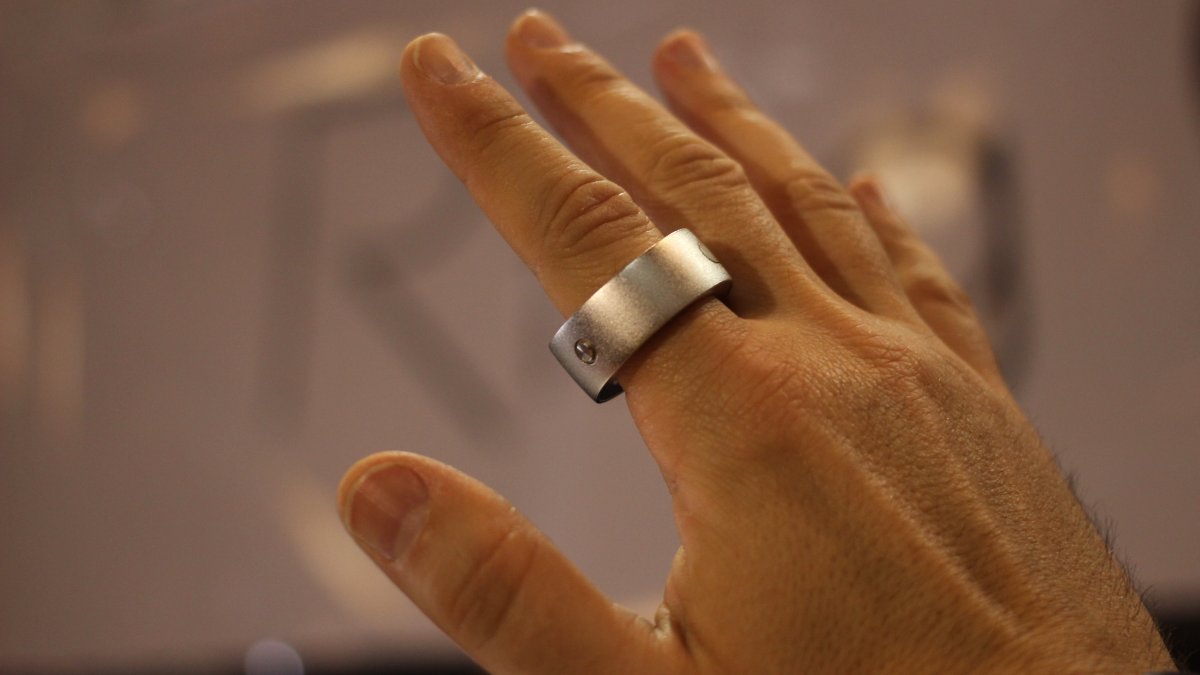
The AI agent industry has a missing input device, and a hardware startup thinks it is a ring. Natura, founded by Carlo Edoardo Ferraris — who previously built the accessories brand Rolling Square — has announced Interface, a $99 smart ring whose entire premise is that you should not need your phone to talk to your agents. Press the button, say what you want, release; the request goes to whichever agent you have assigned to that kind of task.
The routing model is the interesting part. At launch, Interface will connect with Meta\'s Muse, Instinct, Grokbot, Claude and ChatGPT, and the company\'s own product pages list Codex, Claude Code, Hermes, OpenClaw and tinyNature among the supported set, with Natura\'s NatureOS store claiming more than 140 agents. The intended pattern is division of labour: ask Claude to write code, Instinct to book the restaurant, Grokbot to handle the rest. Responses come back through connected earbuds, an iPhone Live Activity, or the NatureOS app, and users decide which agent gets access to which apps and files on their Mac and iPhone, with approval prompts before consequential actions.
The hardware doubles as a conventional health wearable — heart rate, resting heart rate, heart rate variability, sleep stages, daily movement and skin temperature — which Natura says makes it the first ring to combine health tracking with multi-agent access. Battery life is rated at 6 to 12 days depending on usage, with a 100-minute full recharge. A double-press starts and stops recording for meetings and voice memos; the ring stores roughly two hours of audio for later transcription and summarisation by a connected agent.
The economics are the fine print worth reading. The $99 launch price is explicitly introductory — Natura says it plans to raise the price once adoption is established, and after a free period of three to six months it will charge $9 per month. Over a year, the subscription alone exceeds the hardware price. Ferraris argues the manufacturing cost is comparable to the Oura Ring and Samsung Galaxy Ring because they share components, and that the low entry price is a deliberate land-grab for a category that does not exist yet.
His thesis is that personal agents are about to be ubiquitous, and that the last uncontested real estate is the finger. "Ultimately, the main interface between users and technology is going to be the ring," he told TechCrunch, arguing that people want 24/7 agent access — in the shower, asleep, mid-run — without pulling out a screen. Natura\'s previous product, the HumanPods earbuds, pursued the same idea from the ear; the team concluded that voice technology now needs a form factor you never take off.
The caveats are the usual ones for announced-but-not-shipped hardware, plus a few specific to agents. Independent hands-on testing does not exist yet; Android compatibility has not been confirmed; no water-resistance rating or durability spec has been published; and the privacy policy covering voice recordings, meeting notes and biometric data has not been detailed. Every capability described — reordering shampoo from the shower, silencing the TV and setting an alarm from the couch — is a company-stated vision, not a demonstrated one.
Pre-orders are expected to open next month, with shipping slated for December or January. Whether Interface becomes the agent era\'s mouse or its Google Glass depends less on the ring than on the agents it routes to — and on whether users decide that a $9 monthly toll on their own voice is a fair price for never unlocking a phone again.
Comments (0)
Log in to join the discussion
Log InNo comments yet