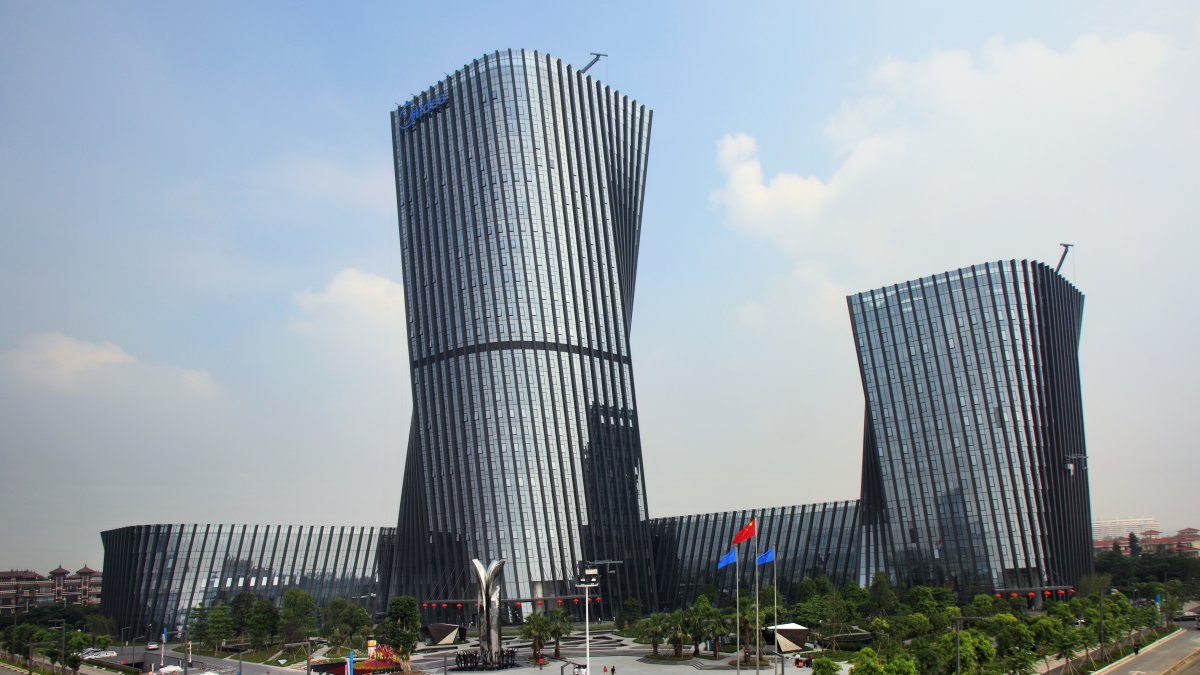
SynapX, the Chinese physical-AI company known in Mandarin as 章鱼动力, has closed several hundred million yuan in new funding, with home appliance giant Midea among the incoming investors, according to an exclusive report from Lanjinger on November 23. The report, citing a person familiar with the deal, said the round also includes well-known financial investors and that the full cap table has not been finalized. Financial outlet 同花顺 later described the round as a Series A led by Midea; SynapX has not published a statement of its own.
The new money lands roughly five months after a $50 million round in June, which was led by Jinqiu Fund, Xinlian Capital and Huangpu River Capital, with Jifu Asia, Houxue Capital, Hong Kong HKTT and Panga Capital participating and Linear Capital following on. Startup media 创业邦 put cumulative fundraising over the past three months at close to one billion yuan and said a further 500 million yuan round is near completion, a figure that sits awkwardly beside Lanjinger's account of an unfinished investor list and should be treated as the company's own framing rather than a settled fact.
SynapX was founded in January 2026 and is run by Du Dalong, who holds an engineering doctorate from Tsinghua, was the sixth employee at Horizon Robotics, served as CTO of the autonomous-driving startup Jizhi Robotics and was a founding member of Baidu's Institute of Deep Learning. The company's bet is unusual for Chinese embodied AI: it does not build complete robots. It builds what it calls a hand-brain productivity platform, pairing dexterous manipulation hardware with a model stack and the data pipeline that feeds it.
That stack is organized around an architecture the company calls SYNTH. SYNData collects multimodal manipulation data covering vision, force and touch; SYNWorld is a world model that learns physical causality and predicts how an action changes the state of the world and the outcome of a task; SYNAction turns those predictions into executable policy. SynapX has also published a three-stage world model roadmap, from generation and interaction, through physics and action, to what it calls optimization of everything, and says it is currently working on the middle stage, where a model stops predicting the next frame and starts predicting physical state and the consequences of acting.
The team is about 100 people and was assembled in roughly four months, drawing from ByteDance's Seed unit, Baidu, Huawei and Meta, according to the company. SynapX says it plans to release its foundation model and a core product in the second half of 2026, and Chinese outlet CNMO reported that the hand-brain platform is targeted for volume delivery by the end of the year, a schedule that depends on line construction, supply chain ramp and customer validation.
Midea's presence is the strategically interesting part. Chairman Fang Hongbo has said the group will spend more than 60 billion yuan over three years on embodied intelligence and AI, and its Welling subsidiary is expanding precision reducer capacity in Foshan by 300,000 units to supply both industrial robots and humanoids. A researcher quoted by Lanjinger argued that Midea is buying underlying capability that fits its own manufacturing and supply chain rather than funding another robot brand, which is the logic that has driven a wave of appliance and automaker money into Chinese robotics this year.
Where the money goes is also a signal. The report says the proceeds are earmarked for a high-end dexterous-hand production line and embodied model research, not for demos or leaderboard runs. That is consistent with the industry's current inflection: with several Chinese companies standing up ten-thousand-unit lines in 2026, the scarce assets have shifted from a convincing video to repeatable parts, uptime and a data flywheel that keeps improving after deployment.
The open question is the one that follows every pre-product round in this sector. SynapX has disclosed no customers, no unit economics, no pricing and no independent evaluation of its manipulation performance, and its most detailed public artifact is a roadmap rather than a shipped system. Midea's balance sheet can carry that ambiguity for a while; the second half of 2026, when the foundation model and the platform are supposed to arrive, is when the claims have to survive contact with a factory floor.
Comments (0)
Log in to join the discussion
Log InNo comments yet