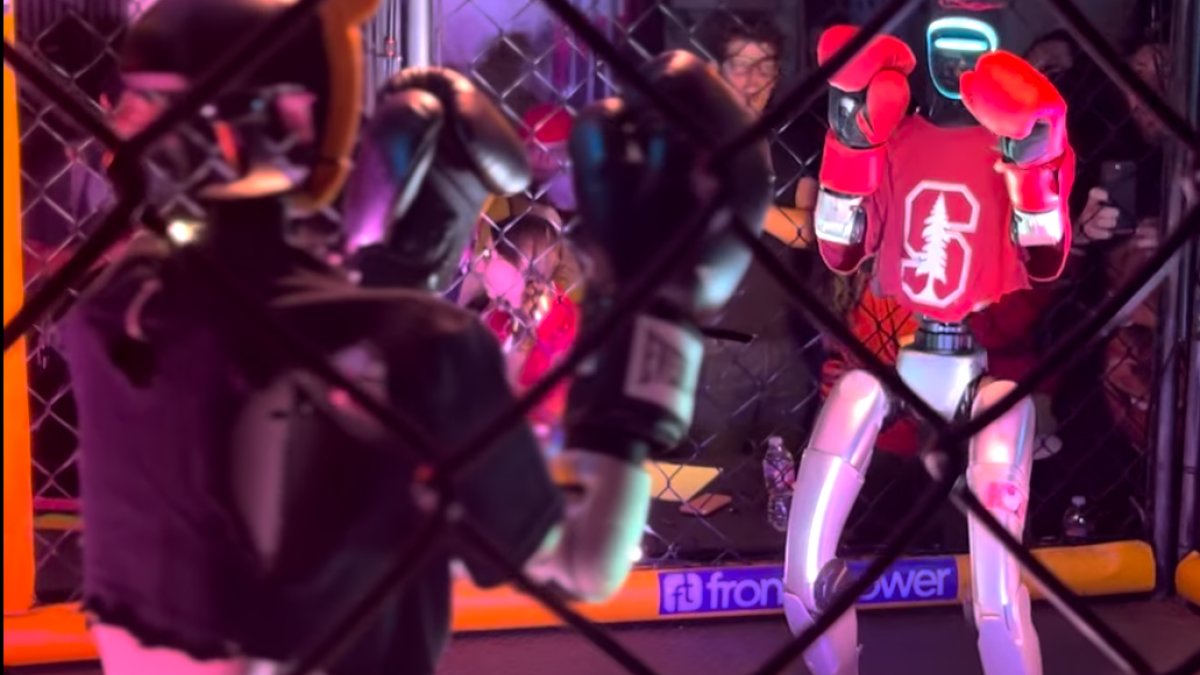
The future of combat sports arrived in San Francisco last month, and California's athletic regulator has already flagged it for unsportsmanlike conduct. REK, a robotics startup that stages full-contact humanoid robot fights, has received a cease-and-desist order from the California State Athletic Commission (CSAC) after hosting what it billed as a real human-versus-robot cage match. Founder and CEO Cix Liv shared the letter on social media this week, where it promptly went viral.
The order targets a September 18 event in which YouTuber Frankie LaPenna entered a fighting cage and faced off against three different humanoid robots, one after another. REK had promoted the spectacle as "Real pilots, real punches. Humanoid robots in brutal, full-contact combat," and a "world's first" human versus Terminator-style robot fight. It was, at minimum, effective marketing for the company's robot-fighting platform — which sells private robot-vs-robot events starting at $10,000 and lets aspiring pilots train on its Real Robot Simulator, available on Steam and Meta Quest, with Pro-level qualifiers earning a shot at piloting real machines in live events.
The CSAC's letter is narrower than the headlines suggest, and more precise. It orders REK to stop "holding, promoting, or advertising any boxing or mixed martial arts contest, match, or exhibition, involving any human in the State of California" without the commission's prior approval, and warns that unlicensed promotion or participation is a misdemeanor under Business and Professions Code sections 18640, 18870 and 18878. The trigger, in other words, is the human. As Tom's Hardware observed, the commission regulates combat sports where at least one party is a person — a robot-only fight card would apparently not have drawn the letter.
One accuracy note that most viral posts skipped: the humanoid robots were not autonomous AI. Independent reporting describes them as remotely operated by human pilots, meaning the cage held a human versus a human — one simply wearing 200 pounds of actuated exoskeleton. That makes the safety question more mundane and more serious at once: heavyweight machinery under teleoperation, swinging at an unprotected content creator, under no athletic commission's rules.
The regulatory gap the order exposes is real. Combat sports law was written for humans hurting humans, with weight classes, medical suspensions and referees. It has no category for a headline act that is "at least one party is a human" — nor for the marketing incentive to blur the line between sport and stunt. REK's replays remain on YouTube, and the company has not said whether its live schedule for the rest of the year survives the letter. Liv, for his part, has treated the cease-and-desist as content, which may be the most 2026 detail of all.
Robot fighting itself is not going anywhere — BattleBots ran for decades on television, and robot-versus-robot events sit outside CSAC's jurisdiction entirely. What changed on September 18 is that a startup put an unprotected human in the loop, on camera, and dared a regulator built for boxing to notice. It noticed. The next promoter planning "human vs. robot" as a marketing hook now has a misdemeanor statute to read first.
Comments (0)
Log in to join the discussion
Log InNo comments yet