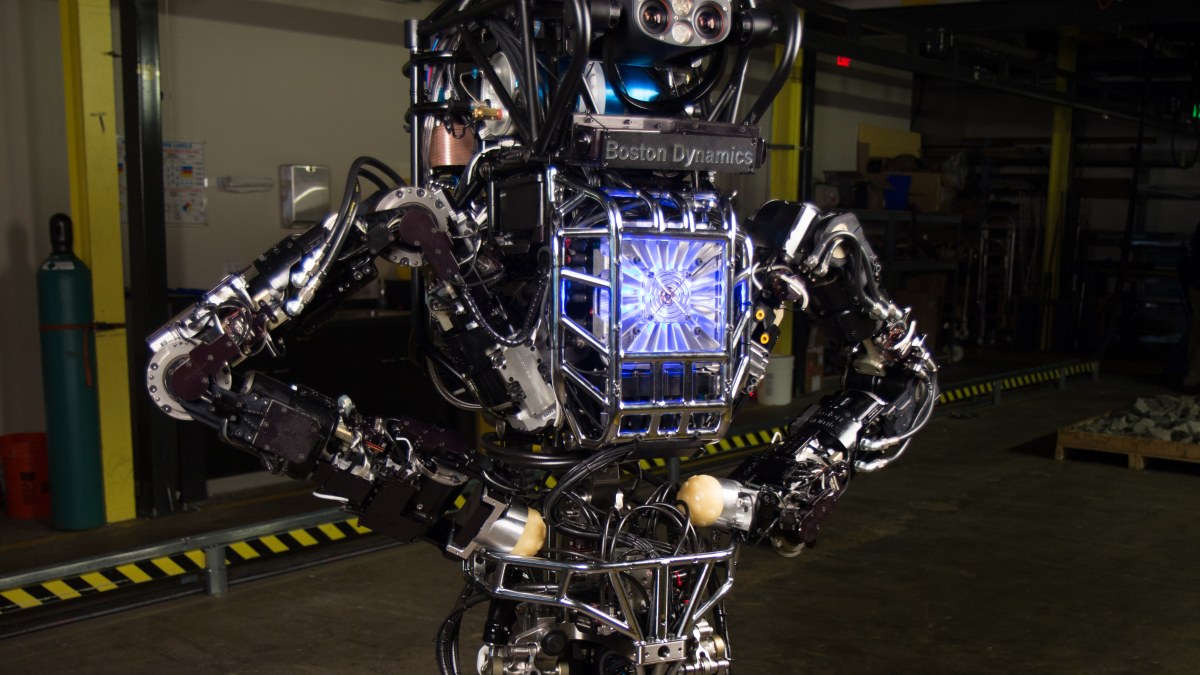
Boston Dynamics showed off a new hand for its Atlas humanoid on October 1, and the most interesting thing about it is what is missing. The hand has four fingers and 13 degrees of freedom, nearly double the seven of the previous three-fingered design it calls GR2 and a newer hand the company's video identifies as GR3. There is no pinky.
The geometry is straightforward. The opposable thumb carries four degrees of freedom and each of the other three fingers carries three, the arrangement giving roughly the size of a large human hand — a constraint that follows from Atlas being built to work with human-scale tools and equipment. The fingers can spread apart, the thumb can slide along and across them, and the hand supports pinch grasps, three-point grasps and tool grips, along with in-hand reorientation and recovery from a slipped grasp. Dense pressure sensors cover the fingertips and the palm, complementing the joint-position sensing that comes free with the design.
Dropping a finger was a deliberate trade. Boston Dynamics says the team taped its own ring and little fingers together for a day to feel the practical loss after chief product and technology officer Zack Jackowski asked them to test the question. A fifth finger would have required three more actuators, along with the cost, volume and additional failure points they bring. “There's no pinky because the team determined that the additional dexterity and tasks you'd be able to accomplish is not worth the extra complexity,” mechanical engineer Dylan Thrush said. Alberto Rodriguez, the company's director of robot behavior, framed the whole exercise as balancing competing objectives: “Do we want the hand to have one thumb or two thumbs? Do we really want the hand to have a pinky or not? And most of these don't have straight answers.”
Mechanically, the hand uses direct actuation at the joints with a single actuator type, encapsulated so that no fragile cables cross a joint, and backdrivable transmissions. Backdrivability cuts both ways: it lets external forces move a joint so the robot can sense them through the actuators, and it lets a joint yield under impact rather than destroy its gearbox.
The design was also shaped around simulation. Boston Dynamics says the hand's kinematics and dynamics can be modelled closely enough for reinforcement-learning policies trained in simulation to transfer to hardware, with training free to vary friction, motor characteristics, object geometry and disturbances before anything runs on the robot. The company reports preliminary evidence of sim-to-real transfer in dynamic manipulation, but has not published comparative performance data, and independent testing has not established that four fingers outperform five.
On strength and tools, the hand is in line with the wider platform. Boston Dynamics points to Atlas carrying a loaded mini-fridge weighing more than 100 pounds; the production robot is rated for an instantaneous payload of 110 pounds and a sustained payload of 66 pounds. The advertised applications are drills, powered torque drivers, grinders, nail guns and welding torches, including handling a tool while pressing its trigger.
The context is industrial deployment. Atlas is in training at the Robotics Metaplant Application Center, which Boston Dynamics opened on September 21 inside Hyundai Motor Group's Metaplant America near Savannah, Georgia. Hyundai and Kia plan to take 25,000 of the robots across their global plants in the coming years, with component assembly targeted for 2030. Rodriguez said the company is studying what it would take to produce 100,000 hands a year — a design study, not a production target.
That is the real argument for four fingers. A more human hand is harder to simulate, harder to manufacture and more expensive to repair, and a factory robot has to survive repeated use rather than demonstrate dexterity once. The bet is that a simpler, strong, highly controllable hand covers enough of the task space to be worth building at volume. What it has not yet proven is how that trade-off holds up under sustained commercial shifts.
Comments (0)
Log in to join the discussion
Log InNo comments yet