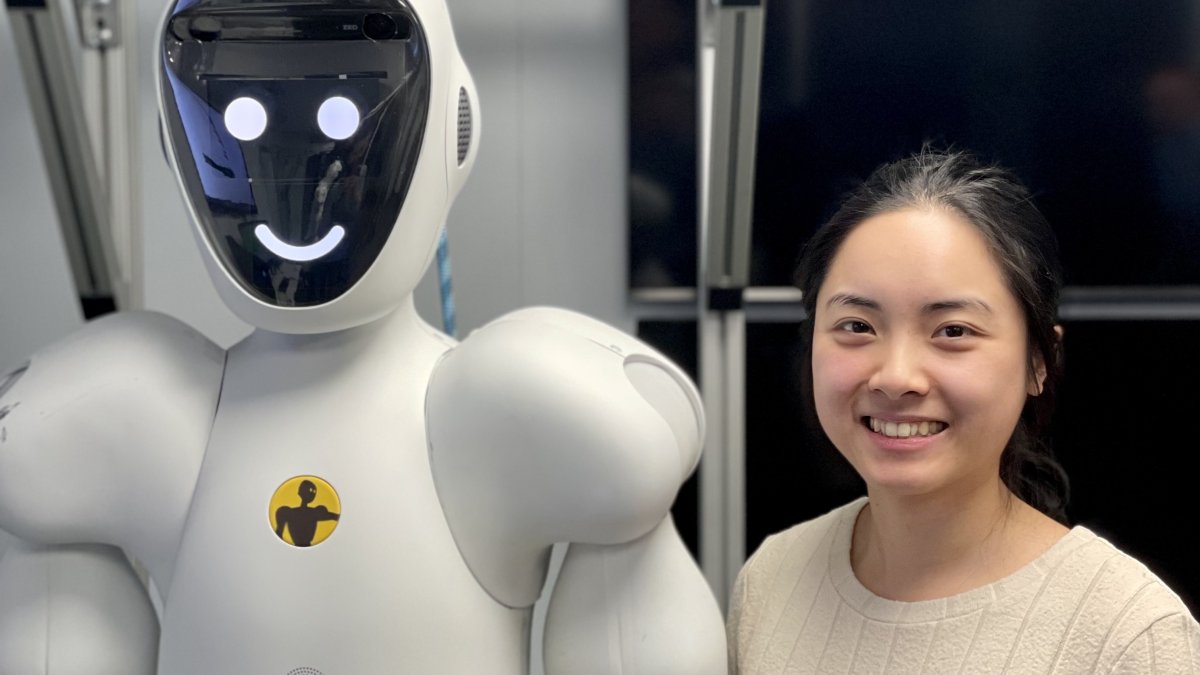
NVIDIA opened its first GTC in Berlin with a package that says less about any single robot and more about who wants to own the plumbing underneath all of them: a major expansion of the Isaac open robotics platform, whose centerpiece is a complete reference humanoid. Munich-based Agile Robots unveiled the Agile ONE SN, a full-stack machine preconfigured with the NVIDIA Isaac GR00T foundation model stack and running on the Jetson Thor edge compute platform, with availability planned for early 2027 and declared interest from Stanford University and ETH Zurich.
The hardware itself is competitive rather than record-setting: 1.40 meters and 40 kilograms, 31 degrees of freedom, a 3-kilogram payload per arm, and dual WUJI Hand 2 five-finger hands that each carry 20 degrees of freedom, 1 kHz force control and tactile sensing. Onboard, Jetson Thor delivers 2,070 FP4 teraflops with 128 GB of unified memory for local reasoning and real-time control, while head and wrist cameras, lidar and inertial measurement units handle perception.
The point of a reference design is what it removes. Robotics teams normally stitch together separate simulation, training and deployment tools before a single skill reaches a physical robot. NVIDIA and Agile Robots claim the unified stack cuts that integration work from weeks to days — a vendor figure, not an independent benchmark — by putting the whole path from data capture to whole-body control in one place. "Today Agile Robots introduced a full-stack, open reference humanoid built on NVIDIA Isaac GR00T, powered by Jetson Thor, giving developers a ready system to create, train and validate the capabilities needed to put humanoids to work," said founder and CEO Zhaopeng Chen.
Beneath the robot sits a refreshed software layer. Isaac Lab 3.0, the open-source robot learning framework, is now generally available with multi-GPU training workflows on physics engines including Newton and PhysX. A new Isaac OS, built on NVIDIA Holoscan, connects models, sensors, control loops and hardware for deterministic real-time behavior from simulation to metal. Three open-source reference workflows for DGX Station show developers how to refine GR00T 1.7 models with reinforcement learning, train dexterous manipulation in Isaac Lab, and post-train Cosmos world models for synthetic data generation.
There is a data play too. The SimReady Central Library ships more than 2,000 simulation-ready robot and factory assets on Hugging Face, contributed by Comau, FANUC, Franka Robotics, Universal Robots, LG Electronics, Robotiq, Standard Bots and Vertiv, among others. The Human 1M Dataset adds human activities with synchronized three-view video and 3D hand tracking, with the full set reserved for Cosmos Coalition partners.
Jensen Huang framed the moment in his usual register: "General-purpose robotics is advancing at extraordinary speed — the ChatGPT moment for robotics is fast approaching." On safety, Agile Robots, Agility, Dexory, FORT Robotics and KION are integrating the NVIDIA Halos stack into their own safety architectures, and SICK is evaluating Halos for dynamic industrial safety. The European ecosystem named around Isaac includes ABB Robotics, KUKA, Universal Robots, Hexagon Robotics and NEURA Robotics.
The strategic read is that the bottleneck has moved from actuators to integration, and NVIDIA is pricing itself into that layer the way it did with CUDA. A reference humanoid is less a product than a calibration target: it gives startups and university labs a known-good baseline, dropping the entry cost of serious humanoid work to engineering time. The counterweights exist — Alibaba, Unitree and BYD all build stacks outside the NVIDIA orbit — but a team choosing a default platform in 2027 will mostly be choosing Isaac, and the concentration risk that implies is now part of the robotics story.
Comments (0)
Log in to join the discussion
Log InNo comments yet