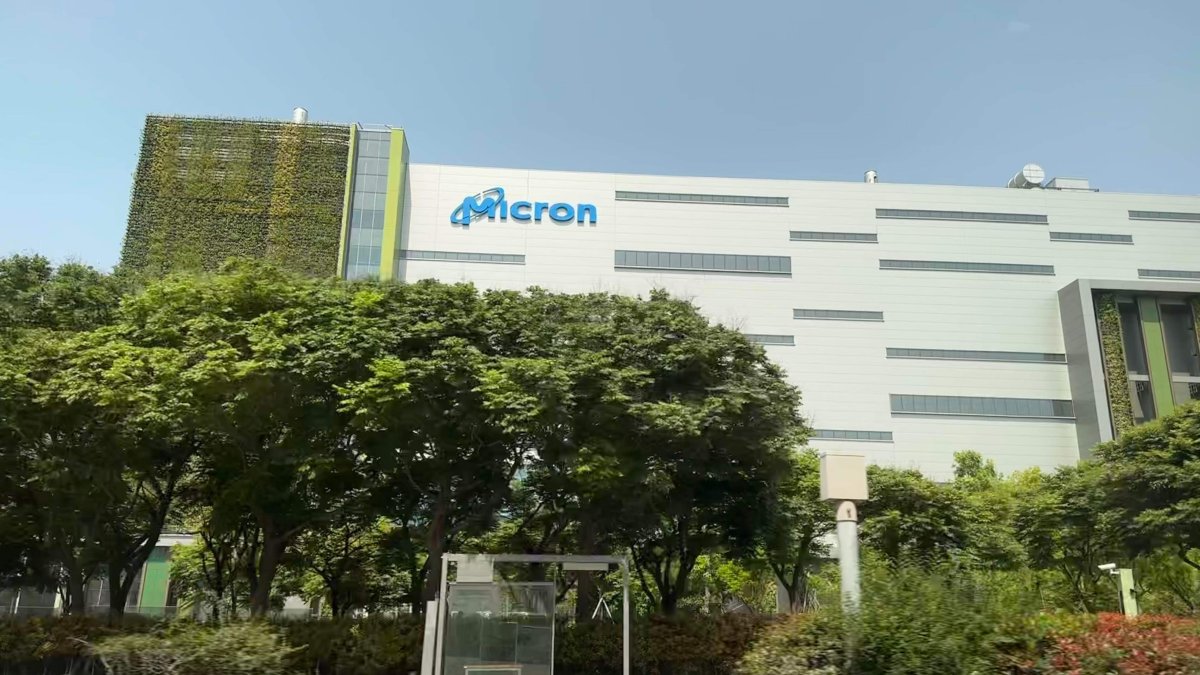
Micron Technology reported record results for both its fiscal fourth quarter and full year on Sept. 30, closing a period in which AI memory demand turned a historically cyclical business into a supply-constrained one. Fourth-quarter revenue reached $54.23 billion for the quarter ended Sept. 3, up from $11.32 billion a year earlier and $41.46 billion in the prior quarter — the company's sixth consecutive record quarter. Adjusted earnings per share came in at $33.42, against an LSEG consensus of $31.61, and full-year revenue rose to $133.19 billion from $37.38 billion.
The center of gravity is now the data center. Micron's Core Data Center Business Unit posted $18.00 billion in quarterly revenue, more than eleven times the $1.577 billion it recorded a year earlier and up from $11.52 billion sequentially, at a 90% gross margin. Data center SSD revenue approached $10 billion in the quarter, more than 10x the year-ago level, and Micron said it expects a fifth straight year of record share in that segment.
Cloud memory, the unit built around high-bandwidth memory, generated $16.28 billion at an 83% gross margin. Micron said HBM shipment growth outpaced total revenue growth, that it has already locked in the bulk of its 2027 HBM bit supply, and that HBM pricing is up sharply year over year. The company is co-developing customized HBM4E with Nvidia for next-generation GPUs and the NVLink Fusion platform. Mobile and client revenue was $13.11 billion at a 90% gross margin, with the newest 1-gamma DRAM node accounting for close to half of that unit, while automotive and embedded revenue reached $6.82 billion, up 47% sequentially.
By product, DRAM revenue was $39.77 billion with average selling prices up by a high-teen percentage sequentially, and NAND revenue was $14.10 billion with ASPs up 30% and bit shipments up 10%. Micron said HBM4 is already shipping in high volume for a lead customer platform, with qualification samples delivered to additional customers, while server LPDDR SOCAMM revenue more than doubled sequentially and multiple 1-gamma server RDIMMs were qualified at 8,800 MT/s.
The most consequential change is contractual. Micron now has 26 strategic customer agreements, up from 16, structured so that customers commit volumes and amounts in advance and largely lose the price declines typical of conventional long-term contracts. The company expects those agreements to account for more than 35% of revenue through 2030, with cumulative customer financial commitments of $32 billion — mostly cash deposits — and roughly three-quarters of the contracts setting price floors and ceilings or fixing prices outright. Some run to 2031. Remaining performance obligations climbed 50% to $150 billion.
Guidance keeps the trajectory intact but flags the bill. Micron forecast fiscal first-quarter 2027 revenue of $61.5 billion, give or take $1.5 billion, well above the roughly $57 billion consensus, with adjusted EPS of $38.15 and adjusted gross margin of about 86.25% — a step down from the 87.0% just reported. Capital spending in the first half of fiscal 2027 is projected at about $25 billion ($11.5 billion in the first quarter, $13.5 billion in the second), versus $27.37 billion for all of fiscal 2026, as new fabs in New York and Boise come online. Micron also raised its planned U.S. investment through 2035 to more than $250 billion.
Chief executive Sanjay Mehrotra pointed beyond servers to physical AI, saying that top-level autonomous vehicles, L4 and above, will carry more than 200 gigabytes of memory plus terabyte-scale solid-state storage — roughly ten times today's L2 and L3 vehicles — and that humanoid robots will generate similar storage demand. He said the company expects an even stronger fiscal 2027.
What it means: Micron's results, coming the same week as warnings that HBM production consumes wafer capacity that would otherwise go to conventional DRAM, confirm a memory upcycle rather than a single-quarter spike. The open question is margin. HBM pricing and take-or-pay contracts protect the top line, but $25 billion of half-year capital spending and rising performance bonuses could compress profitability even as revenue grows — and memory remains a cyclical industry, which the company's own guidance caveats acknowledge. All figures above are the company's reported GAAP and non-GAAP results; the revenue and EPS outlook is management guidance, not a guarantee.
Comments (0)
Log in to join the discussion
Log InNo comments yet