Tencent's Hunyuan team released Hy4 on Wednesday, the finished version of the foundation model it has been previewing for months. The headline number is scale: 770 billion total parameters, up from fewer than 300 billion across the Hy3 series. The company says Hy4 is the first model in the family to ship with vision understanding and the first that can operate a computer, mixing command-line tools with a graphical interface.
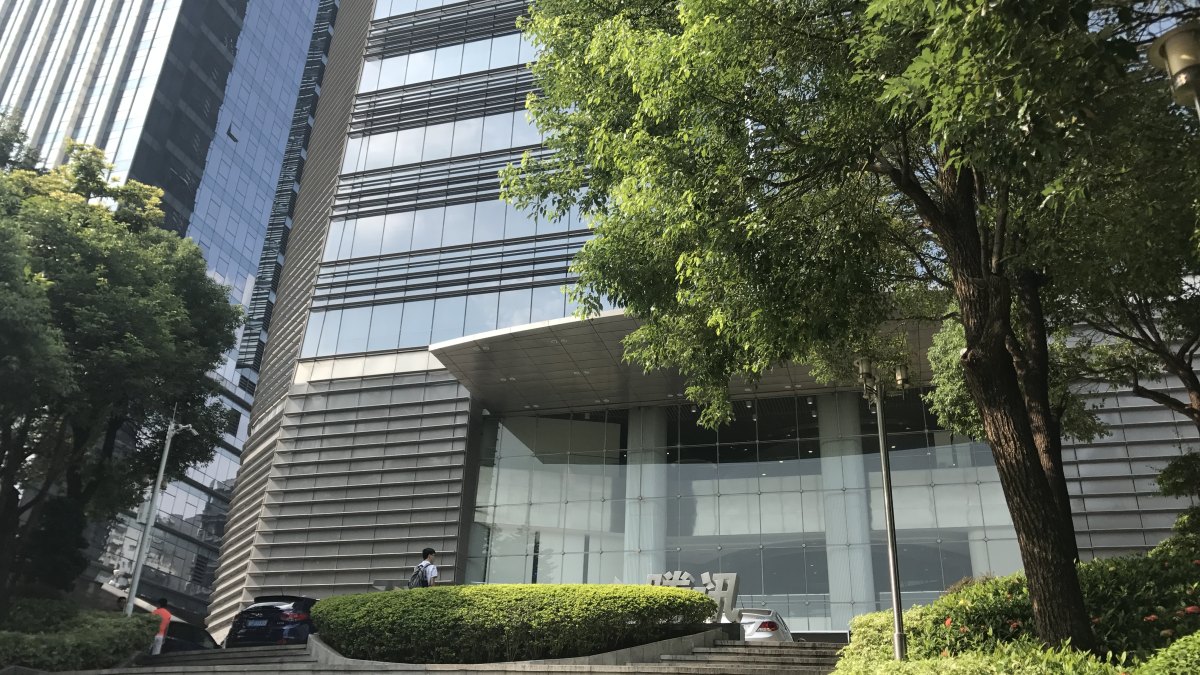
The vision work is aimed at professional software rather than photo captioning. Tencent says it trained Hy4 specifically on Blender and CAD workflows and on long tasks that cross several applications, so the model plans a sequence of steps instead of answering a single prompt. In the demos shipped with the release, Hy4 builds a Three.js scene of the company's Shenzhen campus from a written brief and assembles a playable arcade game, including game logic, from a text description.
Tencent's own numbers put the office-assistant benchmark at 83.18 points with a 96.15 percent task pass rate, and it says the model ranked first in China on nine of twelve scenarios. On financial research the company ran a blind test with its fintech arm: 213 experts, 153 of them from outside Tencent and seven in ten with more than five years of experience, scored 579 real tasks. Hy4 averaged 3.04, against 2.97 for DeepSeek-V4.1-Flash-1017, 2.68 for Kimi K3.1 Pro and 2.68 for GLM-5.3. Every one of these figures is company-run and has not been independently replicated.
The team also reports a drop in fabrication. In its internal tests the hallucination rate fell from 12.95 percent in the preview build to 7.2 percent, and errors caused by guessing fell from 23.1 to 5.6 percent, which it attributes to a search layer built for recency, multi-source merging and fact checking. On game development the model improved 19.1 percent on GameDev and 9.8 percent on GameLogic against the preview, with support for Unreal Engine, Unity and Godot and early work on multiplayer projects.
For science, Tencent cites an internal benchmark called TenureTrail covering seven disciplines and 123 executable research tasks. It also describes a single demonstration: given 84 unordered two-dimensional slices containing 6.99 million cells from a mouse embryo, with mirrored slices and no registration tools or cell-type labels, Hy4 aligned the slices and produced a three-dimensional reconstruction in about 1.5 hours without human intervention. The company says the result was better than the default pipeline of standard registration software.
Weights are not out yet. Tencent says it will open them shortly along with a system card, and it has already published two smaller science models built with the same toolchain, HyCell for single-cell representation and HyPDE for physical fields. On safety, the company says it excluded vulnerability exploitation, reverse engineering and penetration-testing data from training and kept only defensive material, and that audits by its Xuanwu and Keen labs found no standout offensive capability. Its own biology benchmark, Hy-BioExperimentBench, scores Hy4 at 30.4 out of 100, which Tencent reads as strong textbook knowledge but limited ability to design a dangerous experiment.
Pricing is unchanged from the preview: 6 yuan per million input tokens, 18 yuan per million output tokens and 0.3 yuan for cached hits, with a cheaper Hy4 Flash promised next and a 50 percent discount on Tencent Cloud TokenHub through the end of 2026. The model is live in TokenHub, WorkBuddy, CodeBuddy, Yuanbao, the WeCom assistant and ima, with API access through OpenRouter, Hermes and OpenCode.
The strategic subtext is the same one every Chinese lab is now writing down. Tencent says it is preparing Hy4 for recursive self-improvement, using an internal scaffold called Hyra 2.0 to retrain smaller models of the same architecture, and that one of those automatically trained models now beats the official Jev baseline on several tests. The team concedes Hy4 still trails the best closed models and says Hy5 will be larger. But the cadence is the point: since rebuilding its compute base in February, Hunyuan has shipped a major version roughly every two months, alternating previews with finished releases.
Comments (0)
Log in to join the discussion
Log InNo comments yet