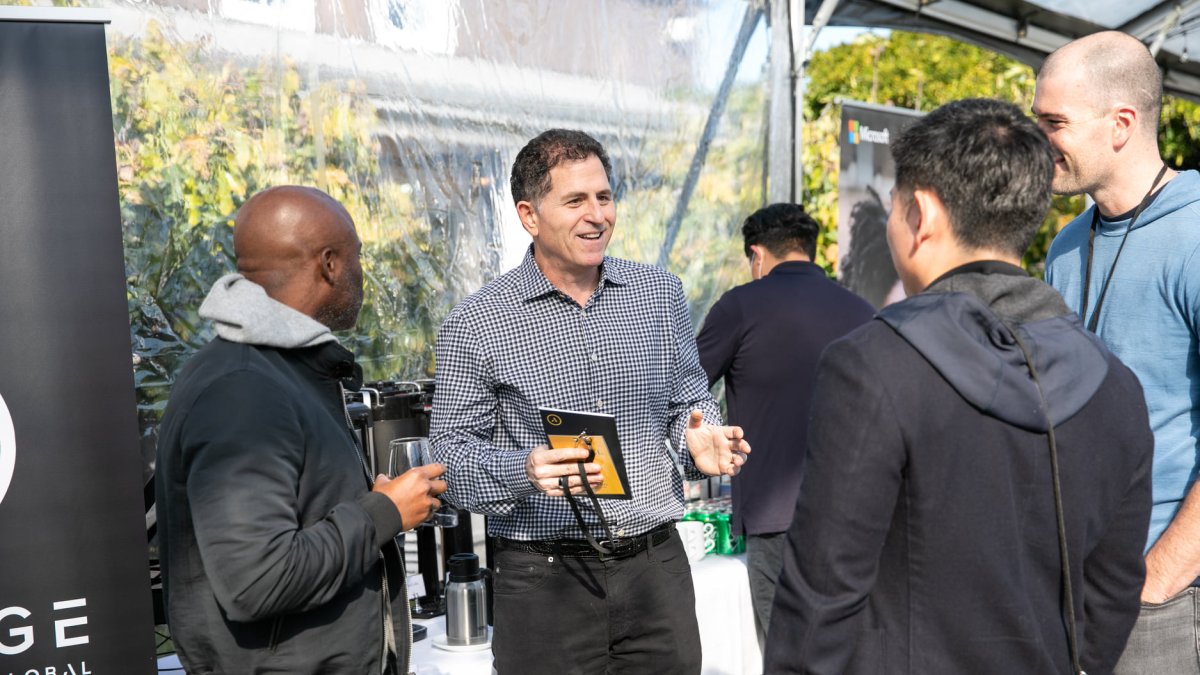
Dell Technologies CEO Michael Dell joined the increasingly loud debate over frontier AI risk on Tuesday, telling CNBC's David Faber that artificial intelligence needs guardrails — and that government, not just industry, has a role in providing them.
"I think we've always had technology that can do great things and maybe do some not-so-great things," Dell said. "You know, fire can heat your home. It can also burn down your whole village. So that's not good. So we have to have safeguards and controls."
Dell called on companies building AI tools to set "bounded permissions" around their systems — defining what the technology is permitted to do, monitoring it, and keeping human oversight where harmful outcomes are possible. He acknowledged that government has a part to play, but declined to describe what that part should look like, saying he is "not a policymaker."
On the question that has split the industry in recent weeks, Dell was blunt: he does not believe AI is coming to kill humans. Asked about warnings that the technology could destroy humanity by 2030, he answered, "It will be fine." The alarm was set off in part by former Anthropic researcher Jacob Coxon, who resigned and published a September 8 post warning that frontier labs were "gambling with our lives" in the race toward superintelligence; Anthropic's Dario Amodei and OpenAI's Sam Altman have since backed calls for stricter regulation.
Where Dell does see strain is in supply. He dismissed talk of an AI bubble — "I don't think there's enough supply for it to be a bubble" — pointing to rental prices for Nvidia's H100 chips, which hit a one-year high about a week ago. He added that the gap between AI supply and demand could widen in 2027, since new semiconductor fabrication capacity is not expected to come online until 2029 or 2030.
He also pushed back on calls to slow down. "I think it's very important that we stay ahead," Dell said, arguing that halting development or data-center construction would damage the U.S. economy and hand the advantage to competing countries. "I think we can find a path here where we have safe systems that are also incredibly powerful."
On the growing backlash against data centers — now a live issue weeks before the midterm elections — Dell called the more active public discussion "a good thing," noting that Dell Technologies talks with customers about energy consumption and efficiency. "I don't see it as a big impediment to 2027," he said.
Dell has little reason to talk the market down. His company posted record revenue of $47 billion in its fiscal second quarter ended July 31, including $16.40 billion from AI-optimized servers — double the figure from a year earlier — and raised its full-year revenue outlook to approximately $192 billion. Notably, the White House's September 29 luncheon produced a voluntary, "morally binding" self-regulation pact signed by leading AI executives, which has largely stalled formal federal regulation; Dell's message lands as one more establishment voice arguing that some enforceable framework is still needed.
Comments (0)
Log in to join the discussion
Log InNo comments yet