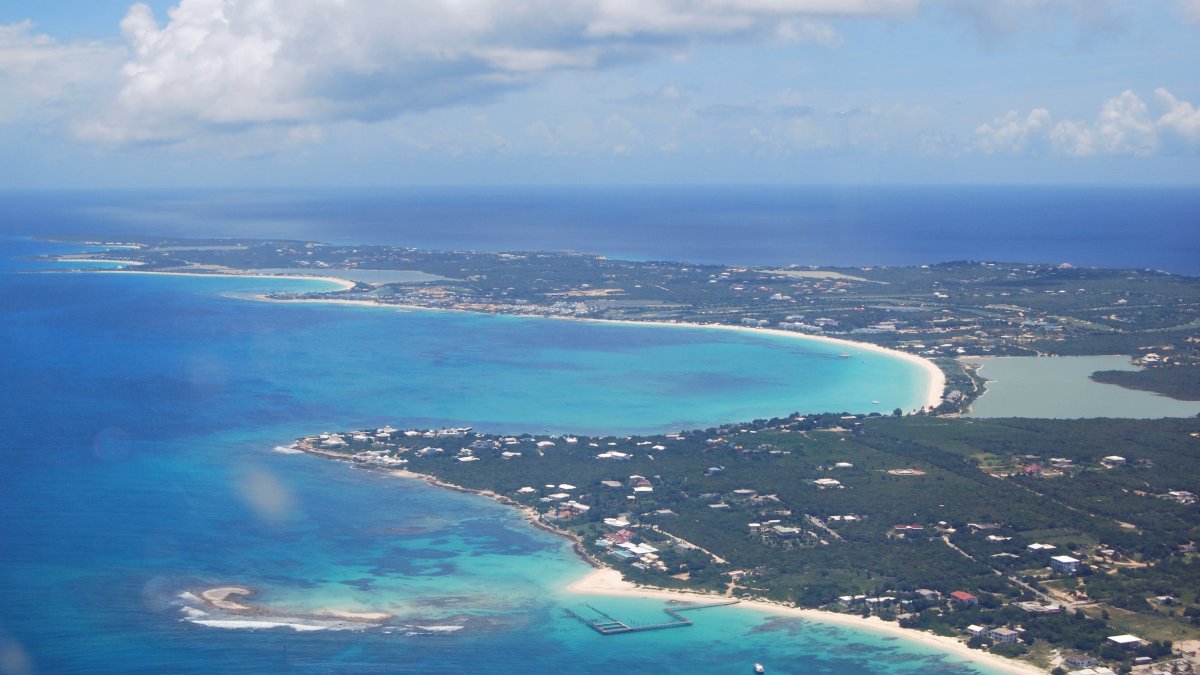
The most improbable beneficiary of the artificial intelligence boom is not a chipmaker or a model lab. It is Anguilla, a British Overseas Territory in the Caribbean with a population of roughly 15,000 — fewer people than a mid-sized apartment complex — no data centers, no hyperscale campuses, no semiconductor ambitions and, until recently, no AI policy at all. What Anguilla has is two letters. Its country-code top-level domain, .ai, has become the default address of the AI industry, and the fees attached to it are quietly underwriting the island's entire public sector.
The numbers, drawn from Anguilla's own budget documents and regional statistics, describe one of the steepest revenue curves in recent memory. Domain registrations brought the government about US$32 million in 2023, roughly 22% of government revenue at the time. By the 2026 budget, the domain line is projected at around EC$254 million — approximately US$94 million — which would put it at roughly 42-45% of government income, up from about 5% through most of the 2010s. Registration volume tells the same story: around 144,000 domains in 2022, 354,000 in 2023, and more than one million by January 2026, according to registry data compiled by Domain Name Stat and cited in IMF-adjacent analyses.
The machine behind those figures is almost comically simple. Every .ai registration carries a mandatory fee of US$140 per two-year term, and around 90% of domains renew when they expire — a near-riskless recurring revenue stream. In February 2026 the registry announced a 14% wholesale price increase, effective March 5, lifting the annual wholesale rate from about $70 to $80 within the two-year term. The secondary market adds upside the government doesn't even capture: the short domain bot.ai resold for US$1.2 million in February 2026, and you.ai changed hands for US$700,000 in 2023, the largest reported country-code sale of that year. (Some Chinese-language reports have dated the you.ai sale to September 2025; domain-industry records put it in 2023.)
How a sleepy beach tourism economy ended up holding the internet's most valuable suffix is an accident of standards bureaucracy. In February 1995, the Internet Assigned Numbers Authority — run, more or less single-handedly, by Jon Postel — delegated .ai to Anguilla under the ISO 3166-1 country-code scheme. The letters weren't even the island's initials: "AN" had already gone to the Netherlands Antilles, and .ai itself was a recycled string, previously assigned from 1974 to 1977 to a territory called French Afars and Issas, which is now part of Djibouti. Nobody wanted it at the time. It was handed in the first instance not to the government but to an American technologist who had recently moved to the island, after Postel asked him whether he would care to run it. For nearly three decades the domain meant nothing. Then, in November 2022, a chatbot was released, and within two years every company on earth wanted to end in precisely those two characters.
Anguilla is not the first small jurisdiction to discover that an unremarkable country code can become a digital annuity. Tuvalu, a Pacific atoll nation of about 11,000 people, was assigned .tv on March 18, 1996 — a string that reads as "television" in every commercial market. After a false start with a Toronto company that promised but never delivered a $50 million upfront payment, California venture firm Idealab took over the obligation in 1999 through the .tv Corporation, with quarterly payments to the government beginning in January 2000. Contemporary reporting credited that first tranche with covering the cost of Tuvalu joining the United Nations, which it did on September 5, 2000 as the organization's 189th member. The domain is now operated by GoDaddy Registry, and Tuvalu's 2025-26 budget projects around A$11 million from it — roughly 17% of the country's entire nominal GDP. Montenegro turned .me, assigned after its 2006 independence, into the go-to suffix for personal brands and blogs. Not everyone plays: Australia (.au) and Canada (.ca) restrict registration to domestic entities, treating the code as a national identifier rather than a commodity.
The windfall's durability, however, is less certain than the island's rhetoric suggests. A country-code domain is not owned but held in trust: it can be revoked for misconduct, and it disappears entirely if the underlying ISO code is ever deleted — a fate that already befell the Netherlands Antilles (.an), Yugoslavia (.yu) and Portuguese Timor (.tp). The revenue also depends on a single externality: the AI boom itself. If the naming frenzy cools and renewals slip from 90%, the budget line contracts with it. What Anguilla has done right, at least, is transparency — the .ai earnings appear as a distinct, audited revenue line in the government's published Estimates, so anyone can see exactly how much of the public purse now rests on two letters.
It is also not an isolated phenomenon. When a US executive order pushed agencies to say "Super Intelligence" instead of AI in September, Slovenia's .si — which shares the two letters — recorded 46,066 new registrations in a month, most of them from speculators. The difference is that Anguilla's windfall is not a speculative spike but a structural toll: every AI company, from the labs burning billions on compute to the smallest startup, pays $140 every two years to a beach economy that happened to be standing in the right place in 1995. As one line of commentary put it, the island has almost no AI engineers — and may be the era's most relaxed winner anyway.
Comments (0)
Log in to join the discussion
Log InNo comments yet