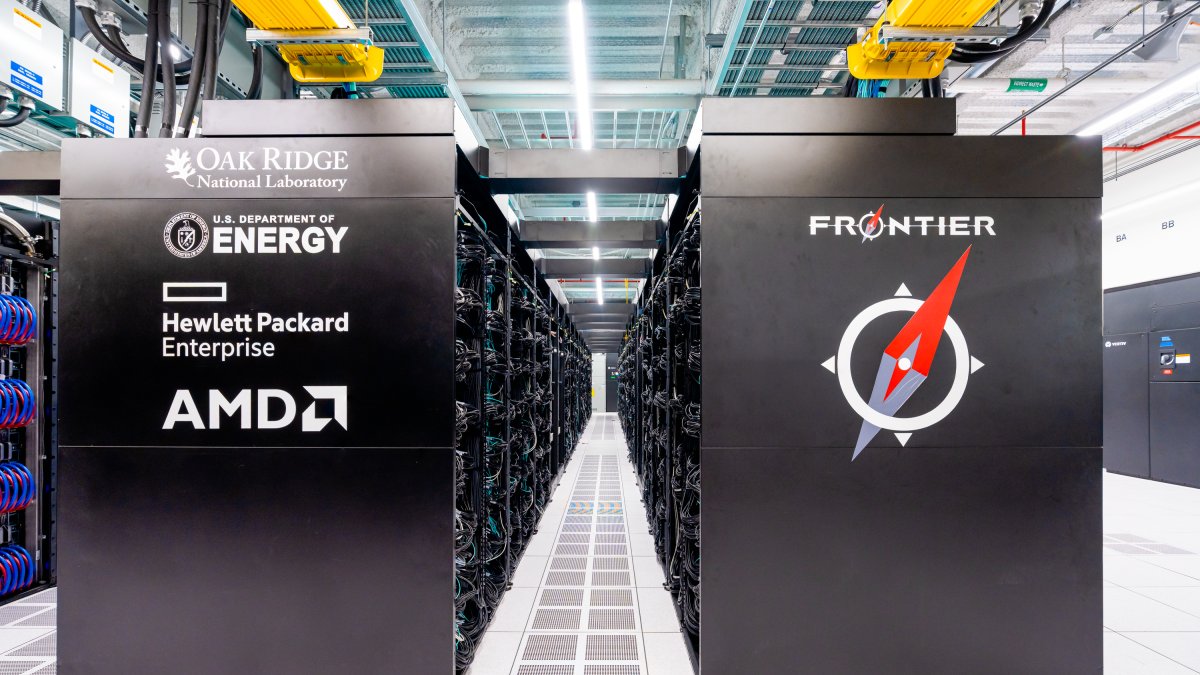
The Lux supercomputer is now open to scientific users at the US Department of Energy's Oak Ridge National Laboratory, AMD announced on November 16 at SC26. Built with HPE through a public-private partnership between AMD and the DOE, Lux debuts at No. 14 on the new TOP500 list with 220.79 petaflops of measured HPL performance, and it is the first dedicated AI factory for the DOE-led Genesis Mission, the national initiative to accelerate AI-driven science.
The system combines AMD EPYC processors, more than 4,000 AMD Instinct MI355X GPUs across over 500 compute nodes, AMD Pensando networking and the ROCm software stack in an HPE-built platform. Each MI355X carries 288 GB of HBM3E memory, putting total system memory capacity at roughly 1.1 petabytes. HPE says the nodes run on its liquid-cooled ProLiant Compute XD685 servers with Juniper Networking QFX switches supporting 800G Ethernet, the first DOE national-laboratory deployment of HPE networking.
Lux is a multi-tenant platform designed to give US researchers cloud-like access for AI training and inference alongside traditional modeling and simulation. Half of its 3.5 million node-hours per year are reserved for Genesis Mission projects, with the other half available for other users. The first allocated projects include AI-assisted fusion power plant design, a foundation-model factory for materials development and advanced manufacturing, and Earth-system prediction for water availability, streamflow and river temperature across the Tennessee Valley Authority region.
The machine is the first deliverable from the roughly $1 billion AMD-DOE partnership signed just over a year ago, which calls for two systems at Oak Ridge. The second, Discovery, is planned for 2028 as the successor to Frontier, the first exascale supercomputer, and is expected to pair AMD's EPYC Venice CPUs with Instinct MI430X GPUs. HPE has also made a $37 million in-kind investment to the program, and AMD is working with Oak Ridge on DOE's American Science Cloud to extend AI and HPC capacity across national laboratories and universities.
The timing overlaps with the November TOP500 release at SC26, and the list context is notable. AMD chips now power 202 of the 500 systems, about 40 percent of the list, up from 191 in June and 177 a year earlier. Only 27 new systems joined the November list, the lowest turnover across the 68 lists published since 1993. China's LineShine system in Shenzhen held the No. 1 spot at 2,198.4 petaflops, and the top ten was unchanged from June.
Lux's debut also frames the next competitive cycle in scientific computing. Nvidia used SC26 to announce Rubin HPC, a scientific-computing GPU due in 2028, which puts it on the same timeline as AMD's Discovery. For now, the DOE has its first purpose-built AI factory, and the researchers who get time on it will test whether pairing frontier-scale AI with simulation can compress discovery timelines in fusion energy, materials and earth science the way the Genesis Mission's name implies.
Comments (0)
Log in to join the discussion
Log InNo comments yet