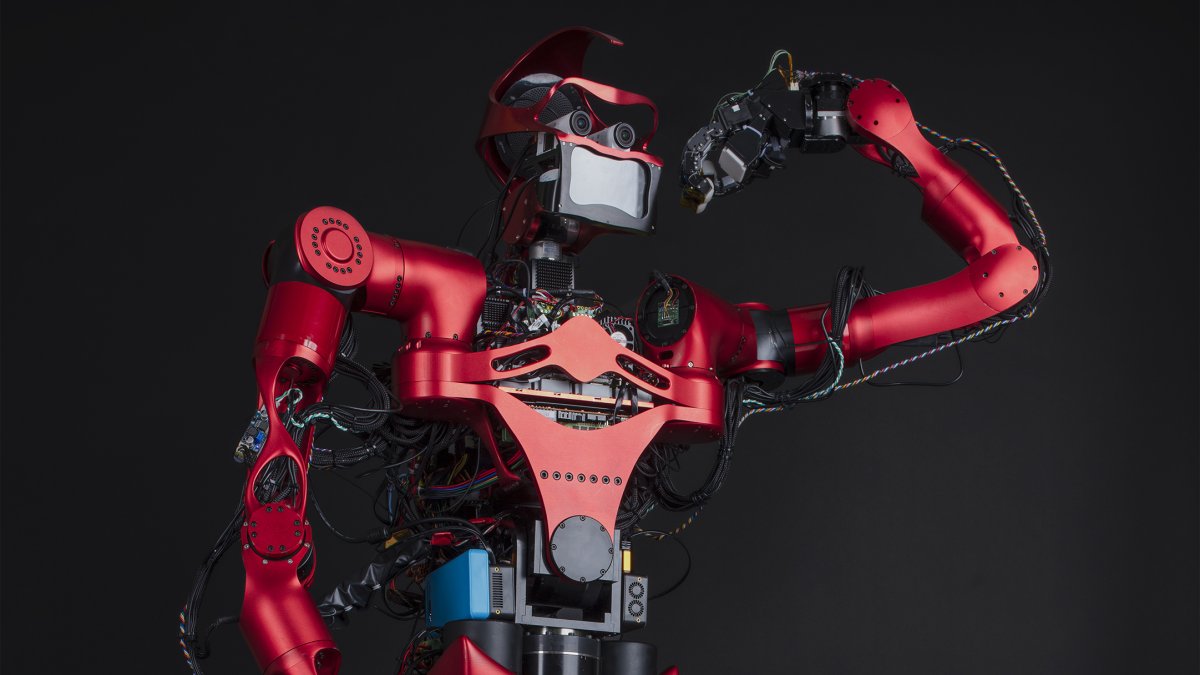
Meta has a humanoid robot, and it took about three months to build. The Information reported Saturday, citing people familiar with the project, that Meta worked with Shanghai-based robot maker Fourier to produce a prototype codenamed Max — roughly 106 pounds, close to five feet tall — and has already started work on a second version. Reuters followed up on the report.
The hardware reads like a small catalog of current robotics practice. Max carries NVIDIA's Jetson Thor chip, has a display that simulates expressive eyes and a mouth, a built-in speaker, and five-fingered hands designed to pick up small objects. The point of the exercise, according to the report, is to give Meta's robotics division a physical platform to iterate against — the robot is viewed internally as a potential body for Meta's Muse AI agent to eventually perform household tasks.
The timeline is the story. Meta's robotics team traveled to China for the collaboration, and Li-Chen Miller, Meta's vice president of robotics product, spent close to two months at Fourier's Shanghai factory. Max was demonstrated to some Meta employees at an internal robotics summit at the end of August. Work on Max 2 began in September; the second version is expected to have a redesigned torso, improved grasping hands, a projector, and additional sensors to help it handle stairs.
Meta told The Information the collaboration with Fourier is focused purely on internal research and experimentation, that there are no current plans to sell the robots, and no launch date has been set. The company has been assembling the pieces for a while: in May it acquired Assured Robot Intelligence, a startup focused on models that help robots understand and adapt to human behavior.
The three-month turnaround says as much about the supply chain as about Meta. Fourier is one of several Chinese humanoid makers benefiting from an industrial base — motors, drives, harmonic reducers — shared with the electric vehicle industry, which is exactly the kind of vendor a US lab needs when it wants a physical prototype fast. Meta is not trying to out-engineer Unitree or Fourier on actuators; it is renting that capability and spending its time on the layer it cares about, the agent that would live inside the robot.
That puts Meta on a well-populated map. Tesla has Optimus, Figure and Boston Dynamics have their own hardware programs with their own funding rounds, and OpenAI's leadership has confirmed it intends to build its own humanoid. The differentiator in this generation is less the body than the software body double it carries — and Meta's argument is that Muse, which already runs across its apps, is the agent people will eventually want in their homes.
The caveats are the usual ones for a leaked prototype: the reporting relies on unnamed sources, a prototype shown to employees is not a product, and Meta explicitly says it is not selling anything. But the direction of travel is now unambiguous — every large consumer AI company wants a robot body, and the fastest way to get one in 2026 runs through a factory in Shanghai.
Comments (0)
Log in to join the discussion
Log InNo comments yet